Claude Opus 4.7: Now Available on Qubrid AI
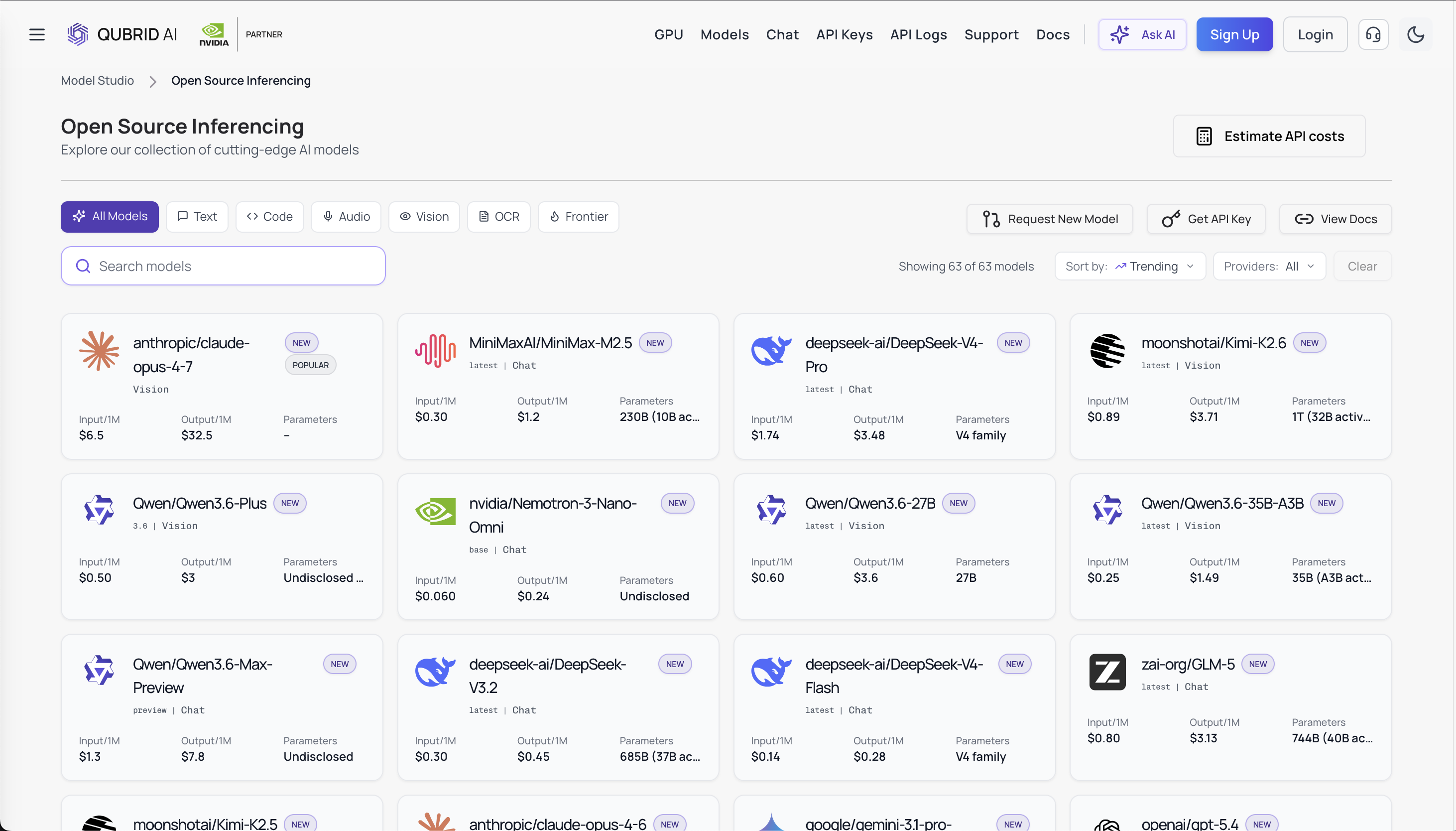
👉 Claude Opus 4.7 available on Qubrid AI: https://platform.qubrid.com/playground?model=anthropic-claude-opus-4-7
There is a particular failure mode that shows up in production AI systems working on hard problems: the model gets partway through a complex task, loses the thread, and produces something plausible but wrong. You catch it in review, adjust the prompt, and try again. Multiply that by the hardest 20% of your engineering backlog, and you have a significant drag on development velocity.
Claude Opus 4.7 is Anthropic's answer to that problem. Released today, April 16, 2026, it's the most capable model in the Opus 4 family, a direct upgrade to Opus 4.6 with major gains in advanced software engineering, autonomous long-running tasks, and high-resolution multimodal understanding. And we're glad to announce it is now live on Qubrid AI, accessible via our playground and REST API with no infrastructure setup required.
👉 Try all models on the Qubrid AI platform: https://platform.qubrid.com/models
What is Claude Opus 4.7?
Claude Opus 4.7 is Anthropic's latest release in the Claude 4 series, a model explicitly optimized for the hardest coding work, complex agentic tasks, and professional-grade outputs. It sits below Claude Mythos Preview in the capability hierarchy, but delivers meaningful improvements over Opus 4.6 across a wide range of benchmarks.
The headline positioning is direct: users are handing off their most difficult coding tasks to Opus 4.7 with confidence. Not the easy ones, the kind that previously needed close supervision. The model handles long-running, multi-step workflows with rigor, pays precise attention to instructions, and verifies its own outputs before reporting back.
👉 Try Claude Opus 4.7 on Qubrid AI: https://platform.qubrid.com/playground?model=anthropic-claude-opus-4-7
What's new: The core upgrades
Advanced Software Engineering
This is the greatest improvement in the release. Opus 4.7 is substantially better at real-world software engineering, particularly on the hardest problems.
Teams that tested it early shared specific numbers. Linear reported a 13% lift in resolution rate on their 93-task coding benchmark, including four tasks that neither Opus 4.6 nor Sonnet 4.6 could solve. Rakuten reported 3x more production tasks resolved on Rakuten-SWE-Bench versus Opus 4.6, with double-digit gains in code and test quality. Cursor reported a 70% resolution rate on CursorBench, up from 58% for Opus 4.6. Notion reported it as the first model to pass their implicit-need tests, understanding what you need, not just what you wrote. Factory AI saw a 10–15% lift in task success for their Droids with fewer tool errors and more reliable follow-through on validation steps.
Across these evaluations, a consistent pattern emerges: Opus 4.7 catches logical faults during the planning phase, before execution, not after the fact. It keeps executing through tool failures that would stop prior Opus versions entirely, and carries work all the way through instead of stopping halfway.
For long-horizon agentic coding workflows, CI/CD automation, autonomous debugging, and multi-file refactoring, this consistency over extended runs is the meaningful differentiator.
Improved Multimodal Vision
Opus 4.7 accepts images up to 2,576 pixels on the long edge (~3.75 megapixels), more than three times the resolution supported by prior Claude models. This is a model-level change, not an API parameter, meaning higher-fidelity image processing happens automatically for all API users.
The practical impact is significant for precision-dependent work. XBOW, which builds autonomous penetration testing tools, reported a jump from 54.5% to 98.5% on their visual acuity benchmark, essentially resolving their single biggest pain point with computer-use agents. Solve Intelligence highlighted gains in reading chemical structures and interpreting complex patent diagrams for life sciences workflows.
More broadly, this opens up computer-use agents that accurately readdense UI screenshots and extract data from complex technical diagrams, and any work that depends on pixel-level visual references.
Instruction Following
Opus 4.7 is substantially more precise about following instructions literally and completely. Where previous models interpreted instructions loosely or quietly skipped parts, Opus 4.7 acts on them exactly.
One practical note for existing users: prompts written for Opus 4.6 may produce different results with Opus 4.7 for exactly this reason. Earlier models that previously glossed over instructions will now execute them precisely. Teams migrating from Opus 4.6 should re-tune prompts and harnesses accordingly.
Memory Across Long Sessions
Opus 4.7 is better at using file system-based memory across long, multi-session work. It remembers important notes and context, applying them to new tasks without needing the same up-front re-explanation on every session. For production agentic systems that run over extended periods, this directly reduces the cost and friction of context management.
Design and Creative Quality
Several early testers noted an improvement they didn't expect: better-looking outputs. Interfaces, dashboards, slides, and documents generated by the model show noticeably higher design quality. Anthropic's own testing highlighted more professional presentations and tighter integration across tasks. For teams using Claude to produce deliverables rather than just code, this is a practical upgrade.
Benchmark performance overview
Claude Opus 4.7 delivers consistent gains across key benchmarks, especially in agentic coding, tool usage, and real-world reasoning tasks. Compared to Opus 4.6, it shows noticeable improvements in SWE-bench performance, computer use, and visual reasoning, while maintaining strong scores in graduate-level reasoning and multilingual understanding.
Capability | Opus 4.7 | Opus 4.6 | GPT-5.4 | Gemini 3.1 Pro | Mythos Preview |
|---|---|---|---|---|---|
Agentic coding (SWE-bench Pro) | 64.3% | 53.4% | 57.7% | 54.2% | 77.8% |
Agentic coding (SWE-bench Verified) | 87.6% | 80.8% | — | 80.6% | 93.9% |
Agentic terminal coding | 69.4% | 65.4% | 75.1% | 68.5% | 82.0% |
Multidisciplinary reasoning (no tools) | 46.9% | 40.0% | 42.7% | 44.4% | 56.8% |
Multidisciplinary reasoning (with tools) | 54.7% | 53.3% | 58.7% | 51.4% | 64.7% |
Agentic search | 79.3% | 83.7% | 89.3% | 85.9% | 86.9% |
Scaled tool use | 77.3% | 75.8% | 68.1% | 73.9% | — |
Agentic computer use | 78.0% | 72.7% | 75.0% | — | 79.6% |
Agentic financial analysis | 64.4% | 60.1% | 61.5% | 59.7% | — |
Cybersecurity (vuln reproduction) | 73.1% | 73.8% | 66.3% | — | 83.1% |
Graduate-level reasoning (GPQA) | 94.2% | 91.3% | 94.4% | 94.3% | 94.6% |
Visual reasoning (no tools) | 82.1% | 69.1% | — | — | 86.1% |
Visual reasoning (with tools) | 91.0% | 84.7% | — | — | 93.2% |
Multilingual Q&A (MMLU) | 91.5% | 91.1% | — | 92.6% | — |
Migrating from Opus 4.6
Two changes affect token usage and should be planned for in production deployments:
Updated tokenizer: The same input may map to more tokens, roughly 1.0–1.35×, depending on content type. This is a tradeoff for improved text processing quality.
More thinking at higher effort levels: Opus 4.7 produces more output tokens on hard problems, particularly in agentic settings across multiple turns. Token budgets should be adjusted accordingly.
Controls available: the effort parameter, task budgets (new in public beta), and direct prompting for conciseness. Anthropic's own testing showed that token efficiency on their internal coding evaluation improves when measured as performance per token across all effort levels, and the additional tokens buy real capability gains.
Getting started on Qubrid AI
Direct API access to Claude Opus 4.7 through Anthropic's platform requires separate authentication and configuration. On Qubrid AI, that complexity is abstracted. One account, one API key, immediate access.
Step 1: Sign up at platform.qubrid.com
Step 2: Find Claude Opus 4.7 in the Model Catalog and experiment in the browser playground, no code required.
Now, enter the prompt, for example: "Can you give me top 10 restaurants in Mumbai for Italian food"

Step 3 (Optional): Generate an API key and integrate. Full documentation at docs.platform.qubrid.com
Here's a minimal Python example to get started:
import requests

response = requests.post(
    "https://api.platform.qubrid.com/v1/messages",
    headers={
        "Authorization": "Bearer YOUR_QUBRID_API_KEY",
        "Content-Type": "application/json"
    },
    json={
        "model": "claude-opus-4-7",
        "max_tokens": 4096,
        "messages": [
            {
                "role": "user",
                "content": "Review this codebase and identify any race conditions or concurrency issues."
            }
        ]
    }
)

print(response.json()["content"][0]["text"])
Real-world use cases
Autonomous Software Engineering: Assign long-horizon coding tasks, multi-file refactors, debugging sessions, and full feature implementations to Opus 4.7 with confidence that it will follow through. It handles tool failures, keeps context across extended runs, and verifies outputs before reporting back.
Document and Contract Analysis: Harvey reported 90.9% accuracy on BigLaw Bench, with the model correctly distinguishing assignment provisions from change-of-control clauses,s a task that has historically challenged frontier models. It handles ambiguous document editing tasks and produces correct, well-cited analysis across complex source material.
Finance and Research Workflows: Anthropic's own testing puts Opus 4.7 at state-of-the-art on the Finance Agent evaluation and GDPval-AA, a third-party benchmark for economically valuable knowledge work across finance, legal, and professional domains. Databricks reported 21% fewer errors on OfficeQA Pro compared to Opus 4.6 when working with source documents.
Computer-Use and Vision Agents: With 3.75MP image support, the model is now viable for a class of computer-use tasks where resolution previously blocked it. XBOW's 54.5% → 98.5% visual acuity result is the clearest signal of what that resolution upgrade means in practice.
Life Sciences and Technical Workflows: Reading chemical structures, interpreting patent diagrams, processing dense scientific figures. Solve Intelligence highlighted Opus 4.7 as the strongest Claude model for life sciences patent workflows, covering drafting, prosecution, infringement detection, and invalidity charting.
Agentic Orchestration: For multi-agent systems where one model coordinates others, Opus 4.7 shows strong role fidelity, reliable instruction-following, and better coordination behavior in complex task graphs with multiple tools and extended context.
Final thoughts
Claude Opus 4.7 is a meaningful upgrade, not an incremental one. The combination of advanced software engineering capability, 3.75MP multimodal vision, precise instruction following, and sustained reasoning over long tasks addresses the specific failure modes that made autonomous AI work unreliable at scale.
The signal is in the numbers: teams are resolving tasks they couldn't resolve before, models are catching their own logical faults before execution, and developers are shipping work that previously required close supervision.
On Qubrid AI, you are one API call away from testing it on your hardest problems.
👉 Try Claude Opus 4.7 on Qubrid AI: https://platform.qubrid.com/playground?model=anthropic-claude-opus-4-7