Kimi K2 Thinking Explained: Architecture, Benchmarks & API on Qubrid AI
Built on a massive Mixture-of-Experts (MoE) architecture, Kimi K2 Thinking is the latest and most capable version of Moonshot AI's open-source thinking model family. It is purpose-built for deep step-by-step reasoning, tool orchestration, and agent-based workflows setting new state-of-the-art results on some of the hardest benchmarks in AI evaluation.
For developers, the best part is straightforward: you don't need specialized hardware. Through Qubrid AI, you can instantly experiment with Kimi K2 Thinking using a web playground or integrate it into applications via API.
In this guide, we'll explore what Kimi K2 Thinking is, how its architecture works, its benchmark performance, its native INT4 quantization, and how you can start using it on Qubrid AI.
What is Kimi K2 Thinking?
Kimi K2 Thinking is a Mixture-of-Experts large language model designed for advanced reasoning, software engineering, and autonomous agent workflows. It starts with Kimi K2 as its base and is trained as a thinking agent one that reasons step-by-step while dynamically invoking tools across hundreds of sequential steps.
Unlike traditional dense models where every parameter is activated during inference, MoE models activate only a subset of parameters per token. This allows the model to scale to extreme sizes without proportional increases in compute cost.
Key Specifications
Feature | Specification |
|---|---|
Total Parameters | 1 Trillion |
Active Parameters | ~32 Billion per token |
Architecture | Mixture-of-Experts (MoE) |
Number of Layers | 61 (including 1 Dense layer) |
Number of Experts | 384 |
Experts Active per Token | 8 |
Shared Experts | 1 |
Attention Mechanism | MLA (Multi-head Latent Attention) |
Activation Function | SwiGLU |
Context Window | 256K tokens |
Quantization | Native INT4 (via QAT) |
Focus Areas | Reasoning, coding, agents, tool use |
Because only a small fraction of the model is active for each token, Kimi K2 Thinking delivers the capacity of a trillion-parameter system while maintaining the efficiency of a much smaller model.
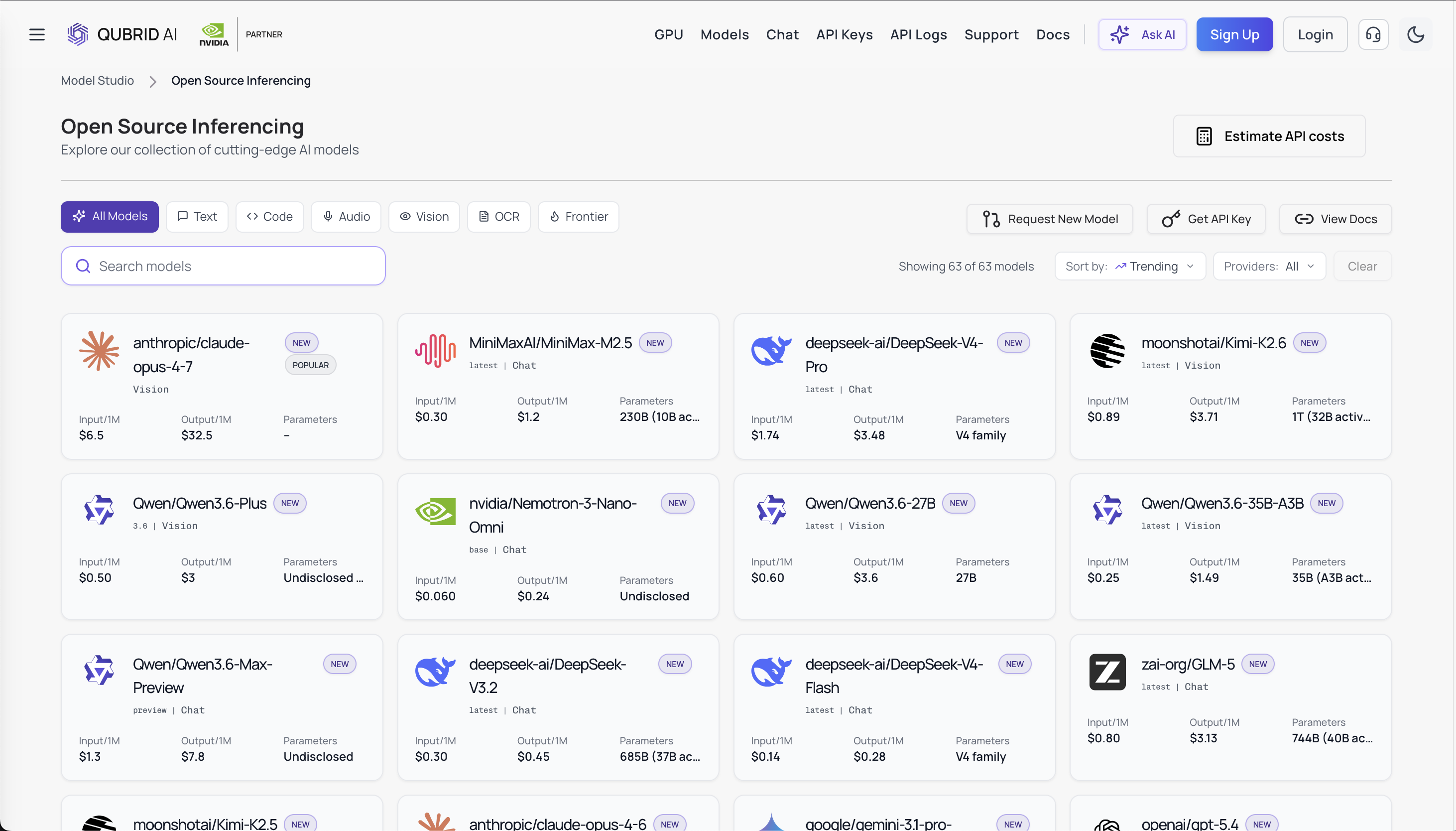
👉 You can try Kimi K2 Thinking on Qubrid AI here: https://platform.qubrid.com/model/kimi-k2-thinking
How the Mixture-of-Experts Architecture Works
To understand why Kimi K2 Thinking is efficient, it helps to understand Mixture-of-Experts (MoE) models. Instead of using one giant neural network, MoE architectures split the model into multiple specialized sub-networks called experts.
Simplified Flow
Input Token
     │
Gating Network
     │
Select Top Experts (8 of 384)
     │
Process Through Experts
     │
Combine Outputs
     │
Final Prediction
The gating network determines which experts process each token. In Kimi K2 Thinking, only 8 of 384 experts are activated per token, plus one shared expert that always contributes.
This design offers several advantages:
Compute efficiency: Only a fraction of parameters are used per token during inference.
Scalability: New experts can be added to increase model capacity without drastically raising cost.
Expert specialization: Different experts can become optimized for specific tasks such as coding, mathematical reasoning, or natural language understanding.
This architecture is what makes an otherwise trillion-parameter model practical to deploy.
Key Features of Kimi K2 Thinking
1. Deep Thinking & Tool Orchestration
Kimi K2 Thinking is trained end-to-end to interleave chain-of-thought reasoning with function calls. This enables autonomous research, coding, and writing workflows that can span hundreds of steps without losing context or drifting from the goal.
2. Stable Long-Horizon Agency
One of the most significant advances in Kimi K2 Thinking is its ability to maintain coherent, goal-directed behavior across 200–300 consecutive tool invocations. Most prior models begin to degrade in quality after 30–50 tool calls. This makes Kimi K2 Thinking significantly more capable for complex multi-step agent pipelines.
3. Native INT4 Quantization
Kimi K2 Thinking uses Quantization-Aware Training (QAT) during the post-training phase. INT4 weight-only quantization is applied to the MoE components, achieving approximately 2x generation speed improvement with minimal performance loss. All benchmark results reported for the model are under INT4 precision.
This makes K2 Thinking one of the few thinking models that benefits from native quantization without the usual accuracy tradeoffs.
4. 256K Token Context Window
With a 256K token context window, Kimi K2 Thinking can process entire code repositories, long research papers, extended conversation histories, and multi-step reasoning chains within a single inference call.
Benchmark Performance
Kimi K2 Thinking has been evaluated across a wide range of benchmarks covering reasoning, general knowledge, agentic search, and coding. The results are compared against models like GPT-5, Claude Sonnet 4.5 (Thinking), Grok-4, and DeepSeek-V3.2.

For more information you can check out Kimi K2 Thinking blog:
👉 https://moonshotai.github.io/Kimi-K2/thinking.html
Reasoning Tasks
Benchmark | Setting | K2 Thinking | GPT-5 (High) | Claude Sonnet 4.5 (Thinking) | Grok-4 |
|---|---|---|---|---|---|
HLE (Text-only) | no tools | 23.9 | 26.3 | 19.8 | 25.4 |
HLE | w/ tools | 44.9 | 41.7 | 32.0 | 41.0 |
HLE | heavy mode | 51.0 | 42.0 | - | 50.7 |
AIME25 | no tools | 94.5 | 94.6 | 87.0 | 91.7 |
AIME25 | w/ python | 99.1 | 99.6 | 100.0 | 98.8 |
HMMT25 | no tools | 89.4 | 93.3 | 74.6 | 90.0 |
HMMT25 | w/ python | 95.1 | 96.7 | 88.8 | 93.9 |
IMO-AnswerBench | no tools | 78.6 | 76.0 | 65.9 | 73.1 |
GPQA Diamond | no tools | 84.5 | 85.7 | 83.4 | 87.5 |
Kimi K2 Thinking outperforms GPT-5 on HLE with tools (44.9 vs 41.7), one of the hardest AI benchmarks in existence. In heavy mode which uses 8 parallel trajectories with reflective aggregation it reaches 51.0 on HLE, surpassing all other models including Grok-4.
General Tasks
Benchmark | K2 Thinking | GPT-5 (High) | Claude Sonnet 4.5 (Thinking) | DeepSeek-V3.2 |
|---|---|---|---|---|
MMLU-Pro | 84.6 | 87.1 | 87.5 | 85.0 |
MMLU-Redux | 94.4 | 95.3 | 95.6 | 93.7 |
Longform Writing | 73.8 | 71.4 | 79.8 | 72.5 |
HealthBench | 58.0 | 67.2 | 44.2 | 46.9 |
Kimi K2 Thinking leads in HealthBench (58.0) among open-source alternatives, significantly outperforming DeepSeek-V3.2 (46.9) and Claude Sonnet 4.5 Thinking (44.2).
Agentic Search Tasks
Benchmark | K2 Thinking | GPT-5 (High) | Claude Sonnet 4.5 (Thinking) | DeepSeek-V3.2 |
|---|---|---|---|---|
BrowseComp | 60.2 | 54.9 | 24.1 | 40.1 |
BrowseComp-ZH | 62.3 | 63.0 | 42.4 | 47.9 |
Seal-0 | 56.3 | 51.4 | 53.4 | 38.5 |
FinSearchComp-T3 | 47.4 | 48.5 | 44.0 | 27.0 |
Frames | 87.0 | 86.0 | 85.0 | 80.2 |
Kimi K2 Thinking leads on BrowseComp (60.2 vs GPT-5's 54.9), a challenging benchmark that requires multi-step web search and reasoning over retrieved content. It also leads on Seal-0 and Frames.
Coding Tasks
Benchmark | K2 Thinking | GPT-5 (High) | Claude Sonnet 4.5 (Thinking) | DeepSeek-V3.2 |
|---|---|---|---|---|
SWE-bench Verified | 71.3 | 74.9 | 77.2 | 67.8 |
SWE-bench Multilingual | 61.1 | 55.3 | 68.0 | 57.9 |
Multi-SWE-bench | 41.9 | 39.3 | 44.3 | 30.6 |
SciCode | 44.8 | 42.9 | 44.7 | 37.7 |
LiveCodeBenchV6 | 83.1 | 87.0 | 64.0 | 74.1 |
Terminal-Bench | 47.1 | 43.8 | 51.0 | 37.7 |
K2 Thinking outperforms GPT-5 on SWE-bench Multilingual (61.1 vs 55.3), Multi-SWE-bench (41.9 vs 39.3), SciCode (44.8 vs 42.9), and Terminal-Bench (47.1 vs 43.8) - demonstrating strong real-world software engineering capability across languages and environments.
Built for Agent Workflows
Kimi K2 Thinking is not just a reasoning model - it is designed specifically for autonomous agent use cases. Its key differentiators for agent workflows include:
Up to 300 sequential tool calls without degradation in task coherence
Interleaved reasoning and tool use: The model seamlessly switches between thinking and calling external tools
Search, code interpreter, and browsing tools: Natively supported in agentic evaluation settings
Heavy Mode: Eight parallel trajectories are rolled out simultaneously, then reflectively aggregated to produce the final result - enabling higher accuracy on the hardest tasks
This makes Kimi K2 Thinking well suited for applications including:
Autonomous coding assistants that generate, debug, and iterate on code
AI research agents that gather, reason over, and synthesize information from the web
Workflow automation systems that coordinate tasks across multiple tools
Multi-step pipelines that require complex planning and execution
Getting Started with Kimi K2 Thinking on Qubrid AI
Running trillion-parameter models locally typically requires significant specialized GPU infrastructure. Qubrid AI simplifies this by providing access to large models through a managed platform so developers can experiment with Kimi K2 Thinking instantly, without worrying about hardware setup.
Step 1: Create a Qubrid AI Account
Sign up on the Qubrid AI platform. Start with a \(5 top-up and get \)1 worth of tokens free to explore the platform and run real workloads.
Step 2: Use the Playground
The Qubrid Playground lets you interact with models directly in your browser. You can test prompts, adjust parameters like temperature and token limits, and explore the model's reasoning capabilities.
Simply select moonshotai/Kimi-K2-Thinking from the model list and start testing prompts. For best results, use temperature = 1.0 as recommended.

Step 3: Integrate the API
Once you're ready to build, you can integrate Kimi K2 Thinking using Qubrid's OpenAI-compatible API.
Python Example
from openai import OpenAI

client = OpenAI(
    base_url="https://platform.qubrid.com/v1",
    api_key="YOUR_QUBRID_API_KEY",
)

response = client.chat.completions.create(
    model="moonshotai/Kimi-K2-Thinking",
    messages=[
        {
            "role": "system",
            "content": "You are Kimi, an AI assistant created by Moonshot AI."
        },
        {
            "role": "user",
            "content": "Solve this step by step: A train leaves Station A at 60 mph. Another leaves Station B at 80 mph. They are 280 miles apart. When do they meet?"
        }
    ],
    temperature=1.0,
    max_tokens=4096,
    stream=True
)

for chunk in response:
    if chunk.choices:
        delta = chunk.choices[0].delta
        if hasattr(delta, "content") and delta.content:
            print(delta.content, end="", flush=True)

print("\n")
Practical Use Cases
Kimi K2 Thinking can power a wide range of demanding AI applications:
AI Coding Assistants: Agents that generate code, debug issues, patch repositories, and iterate through test cycles autonomously
Autonomous Research Agents: Systems that browse the web, gather information, reason over sources, and produce structured outputs
Enterprise Knowledge Assistants: Tools that analyze internal documents, technical specifications, and large knowledge bases using the 256K context window
Workflow Automation: Multi-step pipelines that coordinate tool calls across hundreds of steps without losing task coherence
Mathematical and Scientific Reasoning: Applications requiring rigorous logical problem solving, including STEM research assistance and education tools
Why Developers Use Qubrid AI
Qubrid AI provides a practical way for developers to access large models without infrastructure complexity.
Key advantages include:
No GPU setup required: Run trillion-parameter models without managing hardware
Fast inference infrastructure: The platform runs on high-performance GPUs for low latency
Unified API: Multiple models accessible with the same API pattern
Playground to production: Test prompts in the browser and deploy the same configuration via API
👉 Explore all available models here: https://platform.qubrid.com/models
Our Thoughts
Kimi K2 Thinking represents a significant step forward in open-source thinking models built for real-world developer and agent workflows.
Its Mixture-of-Experts architecture enables trillion-parameter scale with efficient inference. Its native INT4 quantization delivers approximately 2x generation speed without sacrificing benchmark quality. And its ability to maintain stable, goal-directed behavior across up to 300 consecutive tool calls makes it uniquely capable for complex autonomous systems.
With top-tier scores on HLE (with tools), BrowseComp, AIME25, and SWE-bench Multilingual often beating or matching models like GPT-5, Grok-4, and Claude Sonnet 4.5 Thinking. Kimi K2 Thinking is one of the most capable open-source models available today.
For developers who want to experiment without dealing with infrastructure challenges, Qubrid AI provides one of the easiest ways to get started.
👉 Try Kimi K2 Thinking on Qubrid AI here: https://platform.qubrid.com/model/kimi-k2-thinking
If you're building reasoning agents, coding assistants, or complex multi-step AI pipelines, Kimi K2 Thinking is definitively a model worth exploring.
👉 See complete tutorial on how to work with the Kimi K2 Thinking model:
https://youtu.be/cIv5OB4MNUU?si=bACLuiLZn1MIulKC