Top 5 Fastest Models on Qubrid AI for Low-Latency Applications
Speed isn't a luxury in AI development, it's infrastructure. Whether you're shipping a real-time chatbot, an autocomplete feature, or a high-traffic API, model latency directly affects user retention, infrastructure costs, and how far your product can scale. And yet, most developers default to reaching for the biggest, most capable model on the shelf. That's often the wrong call.
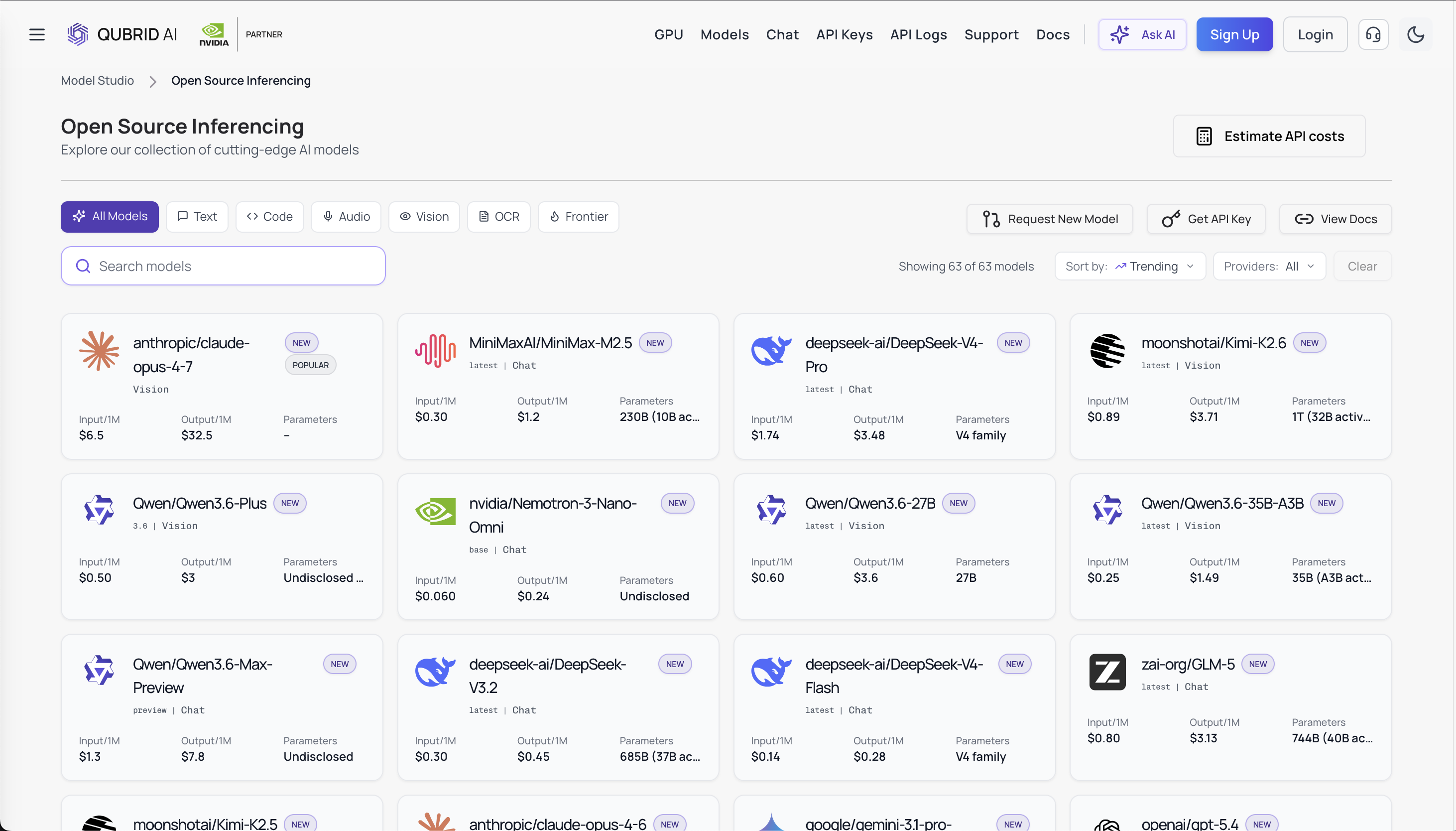
Qubrid AI has one of the most diverse AI model catalogs available to developers today, spanning compact 7B models to reasoning giants with over 120B parameters. But bigger doesn't mean better when milliseconds matter. This post breaks down the top 5 fastest models on Qubrid AI, why they're fast, and when you should reach for each one.
What Makes a Model Fast?
Before jumping into the list, it helps to understand the architecture signals that separate low-latency models from high-latency ones.
Flash and Nano variants are explicitly built for speed. They trade some reasoning depth for dramatically lower inference time and cost per token. Mixture-of-Experts (MoE) architecture is the other major factor.
A MoE model might have 30B total parameters, but only activates a small subset (say, 3B) for any given token. Since compute scales with active parameters, not total parameters, a well-designed MoE model can outrun a much smaller dense model. And when all else is equal, a smaller dense model simply runs faster.
Keep these three signals in mind as you read the list.
1. Qwen3.5-Flash
If there's one model to reach for when latency is your only constraint, it's Qwen3.5-Flash. Built specifically for the Flash inference tier, it runs on approximately 3B active parameters via MoE, making it extraordinarily cheap and fast at runtime. Responses are coherent, context-aware, and arrive fast enough for truly real-time applications.
Best for: Real-time chat interfaces, autocomplete systems, high-QPS APIs, and early-stage products where both latency and budget matter.
👉 Try Qwen3.5-Flash model on Qubrid AI platform:
https://platform.qubrid.com/playground?model=qwen3.5-flash
2. Qwen3-VL-Flash
Need speed and vision? Qwen3-VL-Flash is your answer. As Qubrid continues expanding its multimodal offerings, including the upcoming Qwen 3.5 Omni, this Flash-tier vision-language model stands out as the fastest way to handle image and text inputs together. Unlike stitched multimodal pipelines that pay a latency penalty at every handoff, Qwen3-VL-Flash processes both modalities natively in a single pass.
Best for: Image + chat applications, OCR-style document flows, UI copilots, visual question answering.
👉 Try Qwen3-VL-Flash model on Qubrid AI platform:
https://platform.qubrid.com/playground?model=qwen3-vl-flash
3. NVIDIA Nemotron-3 Nano (30B-A3B)
The name is a mouthful, but what matters is this: 30B total parameters, only ~3.2B active at runtime. That's MoE efficiency working exactly as designed. What sets Nemotron Nano apart from the Flash models above is its quality ceiling responses tend to be more grounded and consistent, making it the right pick for production workloads where you can't afford hallucinations but also can't afford 400ms response times.
Best for: Production chatbots, scalable API backends, enterprise assistant deployments.
👉 Try NVIDIA Nemotron-3 Nano model on Qubrid AI platform:
https://platform.qubrid.com/playground?model=NVIDIA-Nemotron-3-Nano-30B-A3B-BF16
4. GPT-OSS-20B
At roughly 21B parameters in a dense configuration, GPT OSS 20B is lean enough to run quickly and capable enough to handle a wide range of general tasks reliably. For teams already familiar with the OpenAI API surface, this model is a natural bridge with the same interface patterns, lower latency, and lower cost. It won't beat the MoE models above on raw speed, but it delivers predictable, consistent output across general-purpose workloads.
Best for: General-purpose generation, budget-conscious applications, teams migrating from OpenAI APIs.
👉 Try GPT-OSS-20B model on Qubrid AI platform:
https://platform.qubrid.com/playground?model=openai-gpt-oss-20b
5. Gemini 2.5 Flash
Rounding out the list is Gemini 2.5 Flash, now available on Qubrid's model catalog. Google's Flash-tier models follow the same philosophy as Qwen's, which optimizes for throughput and streaming speed rather than maximum reasoning depth. Gemini 2.5 Flash performs especially well on streaming response use cases, where time-to-first-token matters as much as total generation time.
Best for: Real-time assistants, streaming UIs, interactive voice or chat experiences.
👉 Try Gemini 2.5 Flash model on Qubrid AI platform:
https://platform.qubrid.com/playground?model=google-gemini-2.5-flash
These didn't make the top 5 but are worth evaluating depending on your specific constraints: Qwen3-VL-8B-Instruct, Mistral-7B-Instruct-v0.3, microsoft/Fara-7B, openai/gpt-4o-mini, and Qwen3.5-35B-A3B (only 3B active, significantly more reasoning power than its Flash siblings).
What to Avoid If Latency Is Your Goal
Not everything in Qubrid's catalog is built for speed. Models like GPT OSS 120B, DeepSeek V3/R1, GLM-5, Kimi K2.5, and Qwen 3 Max are genuinely powerful, but they're optimized for reasoning depth, not throughput.
Reach for them when accuracy on complex, multi-step problems matters more than response time. Using them for simple chat tasks is like hiring a surgeon to put on a bandage.
Try It Yourself
The fastest way to feel the difference isn't reading benchmarks, it's running your own prompts. Qubrid AI's Playground lets you test any model in the catalog instantly, no infrastructure setup required. Load up Qwen3.5-Flash, fire off a prompt, then compare it against one of the 120B reasoning models. The latency difference is immediately obvious.
👉 Explore all model all 70+ models on Qubrid AI platform here:
https://platform.qubrid.com/models

If you're building something that needs to scale, start fast, validate, then move up the model ladder only as your complexity demands it. Qubrid gives you the full stack to do exactly that.