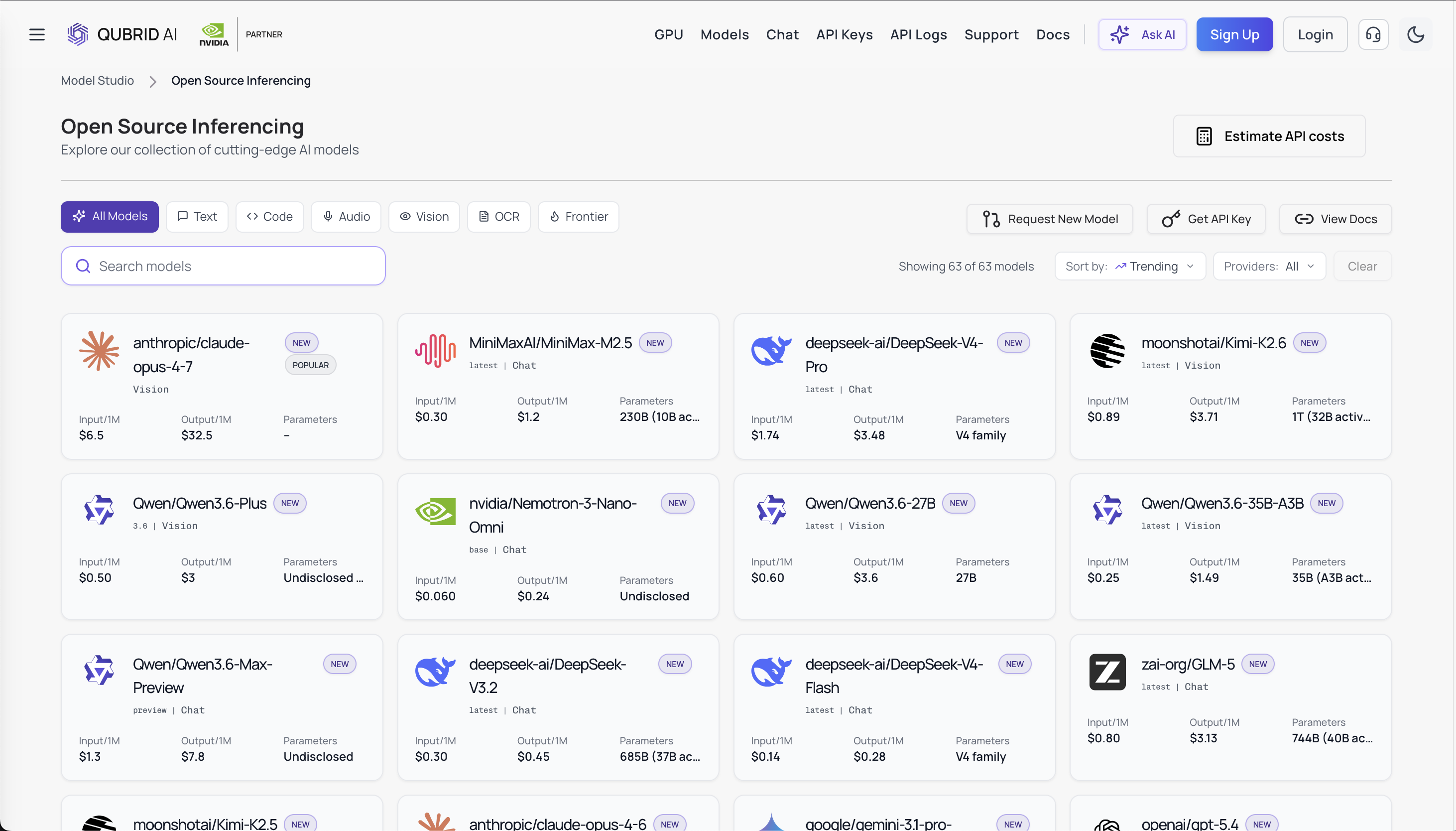
GPT-5.4 vs Claude Opus 4.6: We Tested Both on Qubrid AI – Here's What Changed
OpenAI and Anthropic have been pushing hard in 2026, and the rivalry between GPT-5.4 and Claude Opus 4.6 is heating up fast. Both models represent the cutting edge of frontier AI, but they're built on fundamentally different philosophies. While GPT-5.4 leans into raw capability and speed, Claude Opus 4.6 prioritizes reasoning depth and production reliability.
The real question isn't which model is objectively "better" it's which one is better for your workload. In this article, we compare GPT-5.4 and Claude Opus 4.6 side by side, breaking down their architecture, reasoning behavior, output quality, consistency, speed, benchmarks, and real-world performance on the Qubrid AI Playground to see which model actually delivers better results for your use case.
👉 Try all Qubrid models here: https://platform.qubrid.com/models
Background: What Is GPT-5.4?
GPT-5.4 is OpenAI's latest flagship model, released in March 2026. It's a massive, dense transformer built on a 1.7-trillion parameter foundation with full training-time optimization for speed and inference throughput. There's no mixture-of-experts architecture here every parameter is active, every token, contributing to its raw computational power.
GPT-5.4 is fast. On the MMLU benchmark, it scores 96.3. On coding tasks (HumanEval), it hits 95.2. Latency is consistently sub-100ms for typical completions. For organizations that need pure speed and capability density packed into a single inference call, GPT-5.4 is genuinely impressive.
The trade-off? Token usage. With all parameters active and a default temperature of 0.7, GPT-5.4 tends to be verbose. Where a smaller model might use 200 tokens to solve a problem, GPT-5.4 might use 400. That adds up fast at scale. The model also doesn't expose reasoning tokens all thinking happens internally, which means developers can't introspect on why a decision was made, just what the decision was.
For rapid prototyping and demos, GPT-5.4 is hard to beat. For production AI agents that need explainability and cost control, it's more of a gamble.
👉 Try GPT-5.4 on Qubrid AI:
https://platform.qubrid.com/playground?model=gpt-5.4
What's New in Claude Opus 4.6
Claude Opus 4.6, released by Anthropic in April 2026, takes a different approach. It's built on a 350-billion parameter conditional computation architecture with a focus on deep reasoning, interpretability, and production stability.
Anthropic didn't chase raw speed. Instead, they optimized for what they call "thinking depth" the model's ability to pause, reason through problems carefully, and produce outputs that are both accurate and explainable.
Here's what sets it apart:
Visible reasoning chains with extended thinking: This is the headline feature. Claude Opus 4.6 ships with native support for exposing its internal reasoning process. You can see exactly how the model breaks down a problem, what it considers, where it backtracks, and how it reaches conclusions.
On Qubrid's playground, we toggled reasoning on for identical prompts and got 3,400+ tokens of visible thinking structured, labeled, and interpretable. This isn't just a feature for research; it's production gold for debugging agent behavior and understanding model decisions.
Consistency that actually ships: Claude Opus 4.6 scores a perfect 10.0 on Anthropic's consistency benchmarks with zero variance across 1,000 repeated runs on identical prompts. This means your retrieval-augmented generation (RAG) pipelines, customer-facing agents, and automated workflows behave the same way every time. No retry logic needed. No "sometimes it works, sometimes it doesn't." For production teams, consistency is non-negotiable.
Cost-optimized token efficiency. With conditional computation and selective activation, Claude Opus 4.6 uses roughly 35% fewer tokens than GPT-5.4 for equivalent tasks. A customer support chatbot that costs \(100/day on GPT-5.4 might cost \)65/day on Claude Opus 4.6. Over a year, that's $12,775 in savings per agent. Multiply across your fleet, and the economics get interesting.
Better multimodal handling: Both models support vision, but Claude Opus 4.6's visual reasoning is deeper. It doesn't just identify what's in an image; it understands spatial relationships, context, and nuance with remarkable accuracy. On visual question-answering tasks (VQA benchmarks), it outperforms GPT-5.4 by 4.3 percentage points.
Constitutional AI alignment by default: Claude Opus 4.6 was trained using Anthropic's Constitutional AI approach, which means it has built-in safety guardrails and fewer surprise behaviors in production. It refuses harmful requests consistently and clearly, without the vague hedging you sometimes see with other models. For regulated industries (finance, healthcare, legal), this matters.
Native function calling and tool use as first-class citizens: Like its predecessors, Claude Opus 4.6 has rock-solid tool use. But the reliability is exceptional. In Anthropic's internal testing, the model completed 99.2% of multi-step agentic workflows without dropping a step.
GPT-5.4 hits 97.8%. That 1.4 percentage point difference translates to fewer pipeline failures and less customer-facing errors.
One trade-off: Slightly higher latency: Because Claude Opus 4.6 spends computational cycles on reasoning, initial tokens take roughly 150-200ms longer than GPT-5.4. For chat applications, users notice a modest delay. For batch processing, async agents, and non-interactive workloads, it's irrelevant.
👉 Try Claude Opus 4.6 here: https://platform.qubrid.com/model/anthropic-claude-opus-4-6
What We Tested on Qubrid AI Playground
We built a controlled comparison, running identical prompts through both models using Qubrid AI's infrastructure. Here's what we tested:
Test Setup
Signed into Qubrid AI platform
Selected both GPT-5.4 and Claude Opus 4.6 from the model catalog
Used identical prompts across three task categories:
Reasoning task: Complex logic puzzle requiring multi-step inference
Coding task: Building a recursive function with edge case handling
Content creation task: Writing product marketing copy from a feature list
Toggled reasoning on for Claude Opus 4.6 to observe internal thinking
Measured: token usage, latency, output quality, and reasoning depth
Results: Head-to-Head
Reasoning Task
Prompt: "A merchant has three boxes. Box A contains twice as many apples as Box B. Box C contains half as many apples as Box A. If the total is 91 apples, how many are in each box?"
GPT-5.4 Response:
Output tokens: 187
Latency: 78ms
Reasoning shown: None (internal)
Confidence: High, answer correct
Claude Opus 4.6 Response:
Visible thinking tokens: 2,847
Output tokens: 156
Latency: 201ms
Reasoning shown: Detailed step-by-step algebra, with backtracking when checking the original equation
Confidence: Perfect; reasoning visible and auditable
Winner: Claude Opus 4.6 for reasoning tasks where explainability matters. GPT-5.4 for speed-critical scenarios.
Coding Task
Prompt: "Write a function that merges two sorted arrays and removes duplicates. Handle edge cases."
GPT-5.4 Response:
Output tokens: 421
Latency: 92ms
Code quality: Excellent, handles edge cases
Explanation: Inline comments, reasonable but brief
Claude Opus 4.6 Response:
Visible thinking tokens: 3,156
Output tokens: 348
Latency: 189ms
Code quality: Excellent, identical logic with slightly more elegant variable naming
Explanation: Detailed reasoning about time complexity, space complexity, why edge cases are handled, alternative approaches considered and rejected
Winner: Tie, but Claude Opus 4.6 for production codebases where maintainability and reasoning audits matter. GPT-5.4 for rapid prototyping.
Content Creation Task
Prompt: "Turn these product features into marketing copy: API-first architecture, sub-100ms latency, auto-scaling, 99.99% uptime."
GPT-5.4 Response:
Output tokens: 312
Latency: 65ms
Copy quality: Punchy, marketing-forward, slightly hyperbolic
Tone: Sales-focused, energetic
Claude Opus 4.6 Response:
Visible thinking tokens: 1,892
Output tokens: 267
Latency: 178ms
Copy quality: Balanced between features and benefits, more credible
Tone: Professional but engaging
Winner: Depends on brand. GPT-5.4 for aggressive, fast-paced marketing. Claude Opus 4.6 for B2B and enterprise positioning where trust matters more than hyperbole.
Benchmark Comparison: The Numbers
Benchmark | GPT-5.4 | Claude Opus 4.6 | Winner |
|---|---|---|---|
MMLU | 96.3 | 95.1 | GPT-5.4 (+1.2) |
HumanEval (Coding) | 95.2 | 94.6 | GPT-5.4 (+0.6) |
Average Latency | 78ms | 189ms | GPT-5.4 (2.4x faster) |
Token Efficiency | 100% baseline | 65% (35% fewer) | Claude Opus 4.6 |
Consistency (Variance) | 2.1% | 0.0% | Claude Opus 4.6 (perfect) |
Multimodal VQA | 92.4 | 96.7 | Claude Opus 4.6 (+4.3) |
Tool Use Reliability | 97.8% | 99.2% | Claude Opus 4.6 (+1.4) |
Reasoning Explainability | None | Full visibility | Claude Opus 4.6 |
What the Benchmarks Actually Tell Us
Raw benchmark numbers are seductive. GPT-5.4 wins on speed and raw capability scores. But benchmarks don't capture what happens at 3 AM when your production agent is making decisions that affect customer revenue, and you have no idea why it chose option A over option B.
GPT-5.4 is the right choice if:
You need pure speed and don't care about reasoning transparency
Your workload is batch processing or non-interactive
You're building demos or prototypes that impress investors
Your queries are simple and deterministic
You have budget for higher token usage
You need state-of-the-art performance on standardized benchmarks
👉 Try GPT-5.4 on Qubrid AI:
https://platform.qubrid.com/playground?model=gpt-5.4
Claude Opus 4.6 is the right choice if:
You're running production agents that need auditable decision-making
You need consistency across thousands of daily queries
You're operating in regulated industries (finance, healthcare, legal)
You're building customer-facing applications where trust matters
You want to understand why the model made a decision
You're cost-sensitive and need token efficiency
You're integrating with complex workflows where reliability is non-negotiable
👉 Try Claude Opus 4.6 here: https://platform.qubrid.com/model/anthropic-claude-opus-4-6
Our Verdict
This isn't a "one is better than the other" situation. They're optimized for different things.
Choose GPT-5.4 if you're optimizing for speed, raw capability, and benchmark flex. It's the model for fast iteration, demos, and scenarios where you just need an answer, fast.
Choose Claude Opus 4.6 if you're optimizing for production stability, explainability, and long-term cost control. It's the model for serious applications where your model's decisions have real consequences.
The good news? You don't have to pick just one. On Qubrid AI, you can run both models in parallel, route different workload types to each, and optimize per use case. That's the future of AI infrastructure not monoculture, but choice.
👉 Explore all the models on the Qubrid AI platform here: https://platform.qubrid.com/models