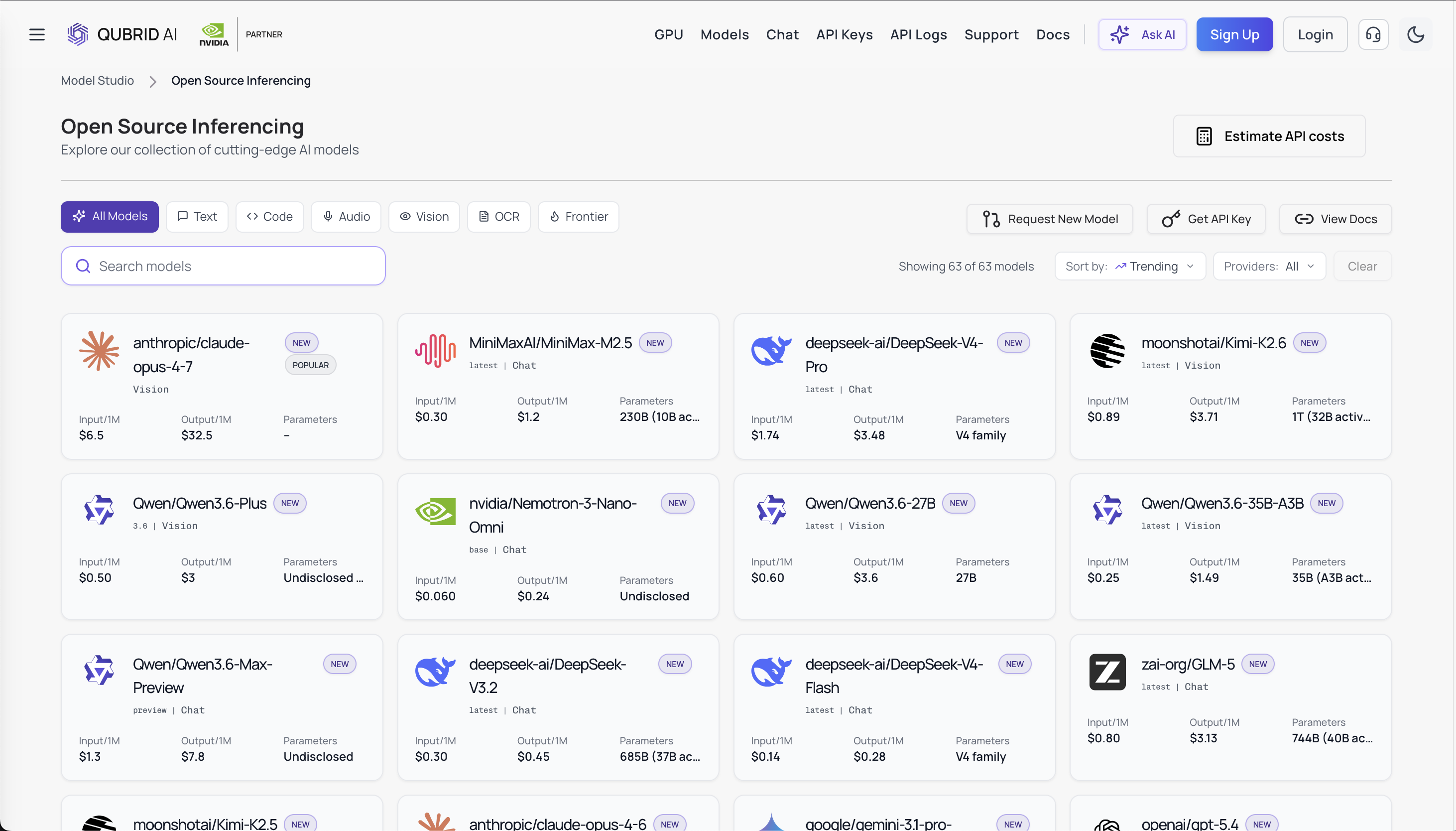
Kimi K2.6 Explained: Long-Horizon Coding, Agent Swarms, Benchmarks & API on Qubrid AI
👉 Try Kimi K2.6 on Qubrid AI: platform.qubrid.com/playground?model=kimi-k2.6
What if your AI agent could spend 13 hours autonomously rewriting the core of a financial matching engine, making 1,000+ tool calls, analyzing CPU flame graphs, and delivering a 185% throughput improvement without a single human intervention?
That's not a hypothetical. That's exactly what Kimi K2.6 did in real testing. And now it's available on Qubrid AI.
Following our earlier deep dives into Kimi K2.5 and Kimi K2 Thinking, this post covers everything you need to know about Kimi K2.6, what changed, what the benchmarks show, and how to start using it right now on the Qubrid platform.
What Is Kimi K2.6?
Kimi K2.6 is the latest open-source model from Moonshot AI, built as a direct upgrade to K2.5. It retains the same Mixture-of-Experts (MoE) architecture that powers the K2 family, 1 trillion total parameters, ~32 billion active per token, 384 experts, and a 256K token context window, but introduces significant improvements in three key areas: long-horizon coding, coding-driven design, and agent swarm orchestration.
If K2.5 established Kimi's credibility as a serious coding and reasoning model, K2.6 pushes that further into a territory that was previously only accessible to top closed-source models.
👉 Try Kimi K2.6 on Qubrid AI: platform.qubrid.com/playground?model=kimi-k2.6
Long-Horizon Coding: The Biggest Leap
The headline improvement in K2.6 is its ability to sustain complex, multi-step coding tasks over extended periods, which Moonshot AI calls "long-horizon coding."
On their internal Kimi Code Bench, K2.6 shows significant gains over K2.5 across a diverse set of engineering tasks: frontend, DevOps, performance optimization, and work spanning Rust, Go, and Python.
Two real-world demos from the release illustrate exactly what this means in practice:
Demo 1 LM Studio beater in Zig: K2.6 was tasked with optimizing the inference speed of a Qwen3.5-0.8B model running locally on a Mac using Zig, a niche systems programming language. Over 4,000+ tool calls and 14 iterations across 12 hours, it improved throughput from ~15 tokens/sec to ~193 tokens/sec, roughly 20% faster than LM Studio.
Demo 2 Financial engine overhaul: K2.6 autonomously rewrote exchange-corean 8-year-old open-source financial matching engine. Across 13 hours and 1,000+ tool calls modifying over 4,000 lines of code, it analyzed flame graphs, restructured thread topology, and delivered a 185% throughput improvement (0.43 to 1.24 MT/s) and a 133% peak throughput gain.
These aren't cherry-picked demos; enterprise partners, including Vercel, Augment Code, Factory.ai, and Blackbox.ai, all independently reported similar results in beta testing. Vercel noted over 50% improvement on their Next.js benchmark compared to K2.5. Factory.ai reported a 15% gain in their internal evaluations.
Benchmark Numbers: Where K2.6 Stands

👉 Explore more on Kimi K2.6 blog here: https://www.kimi.com/blog/kimi-k2-6
Here's how K2.6 compares across key benchmarks:
Benchmark | Kimi K2.6 | Kimi K2.5 |
|---|---|---|
SWE-Bench Verified | 80.2% | 76.8% |
SWE-Bench Pro | 58.6% | 50.7% |
LiveCodeBench (v6) | 89.6% | 85.0% |
Terminal-Bench 2.0 | 66.7% | 50.8% |
HLE-Full w/ tools | 54.0% | 50.2% |
BrowseComp | 83.2% | 74.9% |
DeepSearchQA (f1) | 92.5% | 89.0% |
AIME 2026 | 96.4% | 95.8% |
GPQA-Diamond | 90.5% | 87.6% |
The coding improvements are especially notable. A jump from 50.7% to 58.6% on SWE-Bench Pro is substantial. This benchmark tests real, long-horizon software engineering tasks, not just code generation. The Terminal-Bench 2.0 leap from 50.8% to 66.7% further reinforces K2.6's reliability in agentic, terminal-based workflows.
On the agentic side, K2.6 also overtook K2.5 on BrowseComp by a wide margin (83.2% vs 74.9%), and with its Agent Swarm configuration, that rises further to 86.3%.
Coding-Driven Design
K2.6 isn't just for backend engineers. Moonshot AI introduced a new internal benchmark called Kimi Design Bench, organized across four categories: Visual Input Tasks, Landing Page Construction, Full-Stack Application Development, and General Creative Programming.
K2.6 can generate complete frontend interfaces with hero sections, scroll-triggered animations, and interactive elements from a single prompt. Beyond static pages, it also handles lightweight full-stack workflows: authentication flows, database operations, and session management.
For developers building product demos, MVPs, or AI-generated web applications, this is a meaningful upgrade.
Agent Swarms, Now at 300 Sub-Agents
If you followed our K2.5 coverage, you'll remember that Parallel Agent Reinforcement Learning (PARL) enabled K2.5 to coordinate up to 100 agents across 1,500 concurrent steps.
K2.6 triples that capacity and the architecture now scales to 300 sub-agents executing across 4,000 coordinated steps simultaneously. This isn't just a number; it directly reduces end-to-end latency on complex research, analysis, and multi-format content tasks.
The "Skills" feature is new, too. K2.6 can ingest high-quality files, PDFs, spreadsheets, slides, Word documents, and distill them into reusable skills that preserve the document's structural and stylistic logic. Feed it a McKinsey-style deck, and it can replicate that format for future tasks without re-prompting.
Real swarm examples from the launch include: 100 sub-agents matched against 100 relevant job listings from a single uploaded CV (producing 100 customized resumes), and an astrophysics paper transformed into a 40-page research output, a 20,000+ entry structured dataset, and 14 astronomy-grade charts.
Proactive Agents: 5 Days of Autonomous Operation
K2.6 also powers persistent background agents like OpenClaw and Hermes systems that run 24/7 without waiting for user input.
Moonshot AI's own RL infrastructure team ran a K2.6-backed agent autonomously for 5 days, handling monitoring, incident response, and system operations across the entire lifecycle from alert to resolution.
Their internal Claw Bench (spanning Coding Tasks, IM Ecosystem Integration, Information Research, Scheduled Task Management, and Memory Utilization) shows K2.6 substantially outperforming K2.5 on task completion rates and tool invocation accuracy, especially in workflows requiring sustained operation without human oversight.
Try Kimi K2.6 on Qubrid AI
You don't need specialized hardware or a cloud budget to experiment with K2.6. Qubrid AI gives you instant access via playground or API, the same approach developers have used with our previous Kimi models.
Step 1: Create a Qubrid AI Account
Sign up at qubrid.com. Start with a $5 top-up and get $1 in free tokens to explore the platform.
Step 2: Open the Playground
Head directly to platform.qubrid.com/playground?model=kimi-k2.6 to start testing prompts with K2.6 immediately in your browser. Adjust temperature, token limits, and system prompts to explore its capabilities.
Step 3: Integrate via API
Qubrid uses an OpenAI-compatible API, so if you've used K2.5 before, the switch is straightforward:
from openai import OpenAI

# Initialize the OpenAI client with Qubrid base URL
client = OpenAI(
    base_url="https://platform.qubrid.com/v1",
    api_key="QUBRID_API_KEY",
)

stream = client.chat.completions.create(
    model="moonshotai/Kimi-K2.6",
    messages=[
      {
        "role": "user",
        "content": [
          {
            "type": "text",
            "text": "What is in this image? Describe the main elements."
          },
          {
            "type": "image_url",
            "image_url": {
              "url": "https://cdn.britannica.com/61/93061-050-99147DCE/Statue-of-Liberty-Island-New-York-Bay.jpg"
            }
          }
        ]
      }
    ],
    max_tokens=16384,
    temperature=0.6,
    top_p=0.95,
    stream=True,
    presence_penalty=0,
    enable_thinking=False
)

for chunk in stream:
    if chunk.choices and chunk.choices[0].delta.content:
        print(chunk.choices[0].delta.content, end="", flush=True)

print("\n")
Practical Use Cases for K2.6
Autonomous coding agents that run multi-hour refactoring, debugging, and optimization tasks without hand-holding
Full-stack app generation from a single natural-language prompt
Enterprise document intelligence using the Skills feature to preserve format and structure across outputs
Multi-agent research pipelines that parallelize information gathering, synthesis, and report generation
DevOps and infrastructure automation with persistent agents that can manage incidents and system operations end-to-end
Final Thoughts
Kimi K2.6 is a meaningful step forward from K2.5, not an incremental patch, but a model that genuinely extends what open-source AI can do in production agentic workflows. The combination of better long-horizon coding reliability, expanded agent swarm capacity, and coding-driven design makes it one of the most capable open models available right now.
For developers building serious AI applications, K2.6 is worth testing immediately.
👉 Try Kimi K2.6 on Qubrid AI: platform.qubrid.com/playground?model=kimi-k2.6
👉 Explore the full model catalog: platform.qubrid.com/models