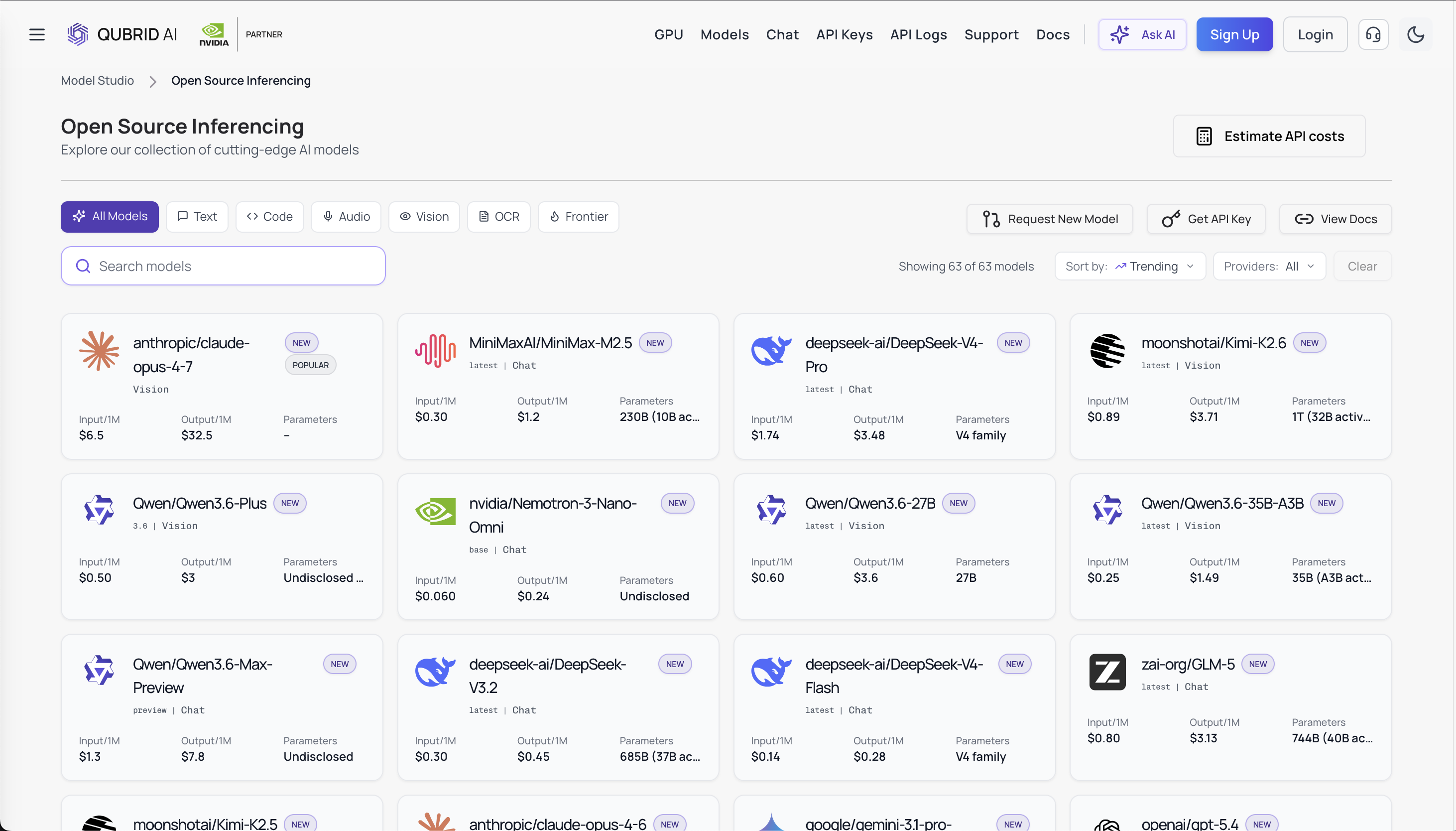
Qwen3.6 Plus vs Qwen3.6 Max Preview on Qubrid AI: Which One Should You Actually Run?
You're building something that matters. Maybe it's an autonomous coding agent, a document-heavy RAG pipeline, or a multi-step workflow that needs to think before it acts. You've heard the buzz around Alibaba's Qwen3.6 family two models, same lineage, very different personalities.
Here's the uncomfortable truth: picking the wrong one won't just cost you benchmark points. It'll cost you latency, money, and in some cases, the quality ceiling your product actually needs.
So let's cut through the noise. Qwen3.6 Plus and Qwen3.6 Max Preview were both built by the same Qwen team at Alibaba, but they're not interchangeable. One was engineered for cost-efficient, context-hungry production workloads. The other was built to win benchmarks and take on the hardest programming challenges in the world. Knowing the difference is the whole game.
Meet the Two Models
Qwen3.6 Plus shipped on March 30, 2026. It's Alibaba's workhorse, designed around a massive 1M token context window, always-on chain-of-thought reasoning, and pricing that undercuts nearly every frontier model available today at approximately $0.29 per million input tokens and $1.65 per million output tokens. If you're processing large codebases, long documents, or running extended multi-turn agent loops, Plus is engineered precisely for that.
Qwen3.6 Max Preview arrived on April 20, 2026, three weeks later, and with a sharper mandate. This is Alibaba's flagship: the model that currently sits at the top of six major programming benchmarks simultaneously, including SWE-benchPro, Terminal-Bench 2.0, SkillsBench, QwenClawBench, QwenWebBench, and SciCode. It's the benchmark king, built to push the outer limits of what a model can do on complex programming and scientific coding tasks.
Try Qwen3.6 Max Preview on Qubrid
Both are proprietary, API-only models. Neither supports self-hosting. And both are accessible today on the Qubrid platform.
Benchmark Breakdown: Where They Actually Differ
Numbers tell the story here. The gap between Max Preview and Plus on programming benchmarks isn't marginal, it's substantial enough to matter in production.
Benchmark | Qwen3.6 Max Preview | Qwen3.6 Plus |
|---|---|---|
Terminal-Bench 2.0 | #1 (+3.8 over Plus) | 61.6% |
SkillsBench | #1 (+9.9 over Plus) | Baseline |
SciCode | #1 (+10.8 over Plus) | Baseline |
NL2Repo | +5.0 over Plus | Baseline |
SWE-benchPro | #1 | — |
QwenClawBench | #1 | Competitive |
A +10.8 jump on SciCode isn't incremental tuning. That's a capability tier shift Max Preview can handle scientific code generation tasks that would meaningfully trip up Plus. The +9.9 improvement on SkillsBench tells a similar story for complex, multi-domain coding challenges.
The NL2Repo result is particularly interesting for teams building repo-level code generation: Max Preview generates entire multi-file repositories from natural language descriptions significantly better than Plus. If you're building an agent that scaffolds codebases from specs, Max Preview is the stronger foundation.
Qwen3.6 Plus counters with one benchmark advantage that matters enormously in practice: context throughput. With a 1M token context window and output speeds reportedly 2–3× faster than comparable frontier models, Plus is the better fit when your workload is wide rather than deep, ingesting entire codebases, running long document pipelines, or maintaining extended conversation state across many agent turns.
The Reasoning Angle: Always-On Chain-of-Thought
One feature that often gets overlooked in model comparisons is how reasoning is surfaced to developers. Qwen3.6 Plus supports a preserve_thinking parameter that exposes the model's internal reasoning trace without requiring any special prompting.
This is genuinely useful for debugging agent behavior. When a model makes an unexpected tool call or produces a surprising output, being able to inspect the reasoning trace is the difference between a 5-minute fix and a 2-hour debugging session. If you're building agents with Qwen3.6 Plus, preserve_thinking is worth building into your logging pipeline from day one.
Max Preview's reasoning capabilities haven't been fully documented yet its context window and many architecture details remain undisclosed. Based on benchmark behavior, it appears to handle complex, multi-step reasoning chains exceptionally well, particularly in programming contexts. But the explicit reasoning trace access of Plus is a Plus-specific development experience advantage worth noting.
Pricing Reality Check
At scale, the cost difference between these two models can be the difference between a product that's economically viable and one that isn't.
Qwen3.6 Plus pricing sits at approximately $0.29 per million input tokens and $1.65 per million output tokens. Max Preview pricing hasn't been publicly disclosed at the time of writing; it's safe to assume flagship-tier pricing will reflect the capability premium.
Run the numbers on a real workload: 100M input tokens and 20M output tokens per month with Plus comes out to roughly $62. That's a strikingly low number for frontier model access. For teams that can use Plus's capabilities, and many can, this changes the economics of what's buildable.
That said, if your workload genuinely needs Max Preview's performance ceiling (scientific coding, complex multi-file generation, top-tier SWE-bench results), paying the premium is justified. Don't optimize for cost at the expense of quality when quality is what your users are actually paying for.
Which Model Is Right for Your Workload?
Choose Qwen3.6 Plus if:
You need a 1M token context window for large codebases, long documents, or extended agent histories
Cost efficiency is a real constraint at your scale
Output speed matters (faster token generation for interactive applications)
You want always-on chain-of-thought with
preserve_thinkingfor agent debuggingYour workload is broad many tasks at moderate complexity rather than a few at extreme complexity
Choose Qwen3.6 Max Preview if:
Peak programming performance is non-negotiable you need the best possible output on hard coding tasks
Your workload involves scientific code generation or complex multi-file repository creation
You're building where benchmark quality directly maps to user-facing quality
SWE-benchPro or SciCode-level task difficulty reflects your real production requirements
You're in the Alibaba/Qwen ecosystem and want the flagship tier without compromise
A Practical Multi-Model Strategy
The most effective teams aren't betting everything on a single model. They're building routing layers.
A simple pattern that works well: use Qwen3.6 Plus as your default handler for the majority of requests. Its cost efficiency and context window make it the right choice for 70–80% of typical workloads. Build a lightweight classifier that itself can power an identification when a request is genuinely hard enough to warrant escalation. Route those high-complexity coding tasks to Qwen3.6 Max Preview.
This approach can reduce inference costs by 50–70% compared to running everything through Max Preview, while preserving peak performance for the tasks where it actually moves the needle.
Try Both on Qubrid
Both models are available on the Qubrid platform today. You don't need to commit to one based on benchmarks alone, run your actual workload against both, and let your data decide.
The benchmark king and the production workhorse. Both available, both ready. The only question is which one fits what you're building.