DeepSeek-V4 Series Explained: Architecture, Benchmarks & API on Qubrid AI
Most open-source AI releases ask you to make a trade-off: raw power or practical speed. DeepSeek's V4 series refuses that bargain. With two models, one built for scale, one built for velocity and a shared architecture that supports a full one million token context window, the DeepSeek-V4 series is one of the most thoughtfully designed open-weight releases to date. Whether you're building latency-sensitive applications or tackling complex agentic workflows, there's a V4 model designed for exactly what you need.
In this post, we break down the entire DeepSeek-V4 series Flash and Pro, base and instruct, every reasoning mode along with the architectural upgrades that make both models tick, benchmark results across coding, reasoning, and agentic tasks, and how you can start using them on Qubrid AI.
What is the DeepSeek-V4 Series?
The DeepSeek-V4 series is a family of Mixture-of-Experts (MoE) large language models released by DeepSeek AI, built around one shared goal: highly efficient intelligence at million-token context scale. Both models in the series were pre-trained on over 32 trillion diverse, high-quality tokens and are released under the MIT license, making them fully open for commercial use.
The series consists of two models with four total variants:
DeepSeek-V4-Flash is the efficiency-first option. With 284 billion total parameters and only 13 billion activated per token, it is designed for fast inference, lower serving costs, and use cases where throughput matters. Notably, its Flash-Max reasoning mode achieves near-Pro-level performance on many reasoning benchmarks when given sufficient thinking budget making it a serious option even for demanding tasks.
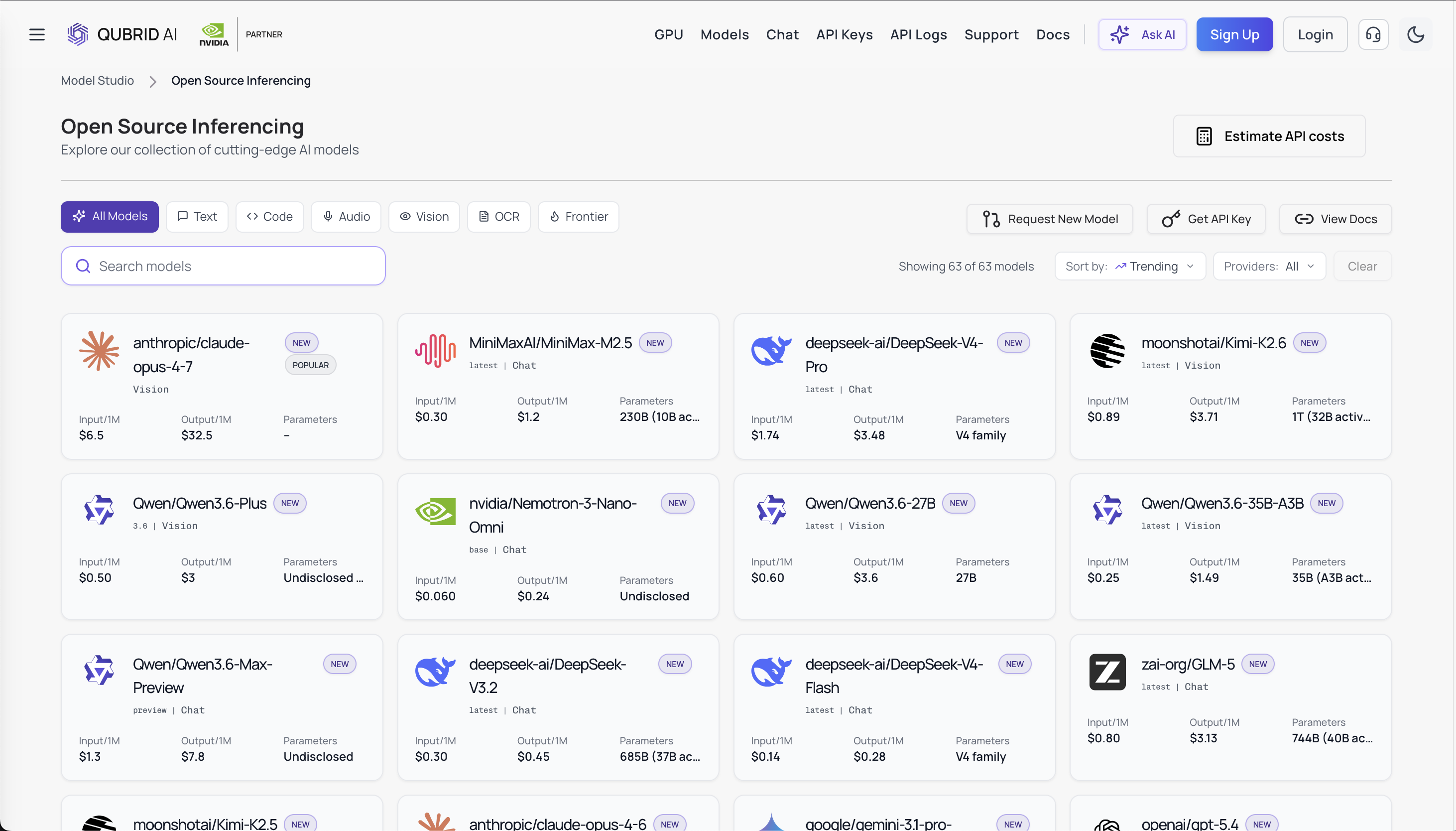
👉 Try Deepseek V4 Flash here: https://platform.qubrid.com/model/deepseek-v4-flash
DeepSeek-V4-Pro is the flagship. With 1.6 trillion total parameters and 49 billion activated per token, it is currently the top-performing open-source model available, leading all models on competitive coding benchmarks and competing directly with GPT-5 and Gemini on reasoning and agentic tasks.
👉 Try Deepseek V4 Pro here: https://platform.qubrid.com/model/deepseek-v4-pro
Both models share the same attention architecture, optimizer, and post-training methodology and both support a 1 million token context window.
Key Specifications
Feature | DeepSeek-V4-Flash | DeepSeek-V4-Pro |
|---|---|---|
Total Parameters | 284B | 1.6T |
Activated Parameters | 13B per token | 49B per token |
Architecture | Mixture-of-Experts (MoE) | Mixture-of-Experts (MoE) |
Context Window | 1 Million tokens | 1 Million tokens |
Precision | FP4 + FP8 Mixed | FP4 + FP8 Mixed |
Pre-training Tokens | 32T+ | 32T+ |
Reasoning Modes | Non-Think, Think High, Think Max | Non-Think, Think High, Think Max |
License | MIT | MIT |
FP4 precision is used for MoE expert parameters; most other parameters use FP8.
How the Hybrid MoE Architecture Works
Both V4 models are built on the same foundation of three architectural innovations that make million-token context practical not just theoretical.
1. Hybrid Attention: CSA + HCA
The core challenge with long-context models is that standard attention mechanisms scale quadratically with sequence length, making them prohibitively expensive beyond a few hundred thousand tokens. DeepSeek-V4 addresses this with a hybrid attention mechanism combining Compressed Sparse Attention (CSA) and Heavily Compressed Attention (HCA). The result is dramatic efficiency: at a 1M token context, DeepSeek-V4-Pro requires only 27% of the single-token inference FLOPs and just 10% of the KV cache compared to its predecessor DeepSeek-V3.2. Long context stops being a bottleneck.
2. Manifold-Constrained Hyper-Connections (mHC)
Deep networks struggle with unstable signal propagation gradients can vanish or explode across many layers, degrading model quality in unpredictable ways. DeepSeek-V4 replaces standard residual connections with mHC, a stronger connection mechanism that stabilizes signal propagation across the full depth of the network while preserving the model's expressive capacity. The result is better training stability and more consistent output quality.
3. Muon Optimizer
Training at trillion-parameter scale requires optimization methods that are both stable and efficient. The Muon optimizer enables faster convergence and greater training stability compared to AdamW, allowing DeepSeek to push further into pre-training without diminishing returns. Both Flash and Pro benefit from this during their respective training runs.
Post-training uses a two-stage approach: first, domain-specific experts are cultivated through supervised fine-tuning and reinforcement learning with GRPO. Then, a unified model consolidation step via on-policy distillation merges distinct domain expertise coding, reasoning, long-context understanding into a single coherent model.
Simplified Flow
Input Tokens (up to 1,000,000)
           │
  Hybrid Attention Layer
  ┌─────────┴──────────┐
  CSA                 HCA
  (sparse)        (compressed)
  └─────────┬──────────┘
            │
      Gating Network
            │
    Select Top-K Experts
    (13B active for Flash /
     49B active for Pro)
            │
  Process via Active Experts
            │
  mHC Residual Connection
  (stabilized signal propagation)
            │
    Combine Expert Outputs
            │
  Reasoning Mode Applied
  ┌────────┬───────────┐
Non-Think Think High  Think Max
  └────────┴───────────┘
            │
     Final Prediction
Key Features
1. Two Models, One Architecture, Complementary Strengths
Flash and Pro aren't redundant they fill different roles within the same deployment. Flash handles high-throughput, latency-sensitive tasks where response speed is critical. Pro handles complex reasoning, deep code analysis, and long-horizon agentic workflows. Both share the same API interface on Qubrid AI, so switching between them requires changing a single parameter.
2. Three Selectable Reasoning Modes
Every instruct variant in the V4 series supports three reasoning effort modes, giving developers direct control over the speed-accuracy trade-off at inference time.
Reasoning Mode | Characteristics | Best For |
|---|---|---|
Non-Think | Fast, intuitive responses | Routine tasks, low-latency use cases |
Think High | Logical, deliberate analysis | Complex problem-solving, planning |
Think Max | Maximum reasoning depth | Research tasks, hardest agentic workflows |
This is especially powerful for agent architectures: use Non-Think for tool dispatch decisions, Think High for planning steps, and Think Max for the hardest reasoning bottlenecks all within the same model.
3. One Million Token Context Window
Both Flash and Pro support a 1M token context window. This means entire codebases, multi-document research sets, or extended conversation histories can be held in a single prompt without chunking or retrieval workarounds. For applications like code review, contract analysis, or long-form document QA, this changes what is architecturally possible.
4. MIT License Fully Open for Commercial Use
Both models are released under the MIT license. No API dependency, no usage restrictions, no fine-tuning limitations. This is one of the very few series at frontier capability level that developers can build on, modify, and deploy in production without licensing constraints.
Benchmark Performance
Coding
DeepSeek-V4-Pro-Max leads the entire frontier on competitive programming. On LiveCodeBench, it scores 93.5% ahead of Gemini-3.1-Pro High (91.7%), Kimi K2.6 Thinking (89.6%), and Claude Opus 4.6 Max (88.8%). On Codeforces, it reaches a rating of 3206 the highest of any model tested, including GPT-5 (3168) and Gemini (3052). Even V4-Flash in Think Max mode reaches a Codeforces rating of 3052, matching Gemini at a fraction of the compute cost.
On the base model side, DeepSeek-V4-Pro-Base scores 76.8% on HumanEval, up from 62.8% for V3.2-Base a meaningful improvement in raw code generation capability.
Knowledge and Reasoning
On GPQA Diamond, V4-Pro-Max scores 90.1%, competitive with Claude Opus 4.6 Max (91.3%) and GPT-5 (93.0%). On MMLU-Pro, the base model scores 73.5% the highest among all three models in the base comparison. On SimpleQA-Verified, V4-Pro-Base jumps to 55.2% from DeepSeek-V3.2's 28.3%, a near-doubling of factual accuracy on difficult knowledge questions. On FACTS Parametric, V4-Pro-Base hits 62.6%, up from 27.1% the sharpest generational improvement in the entire benchmark suite.
Long Context
At a full 1 million token context, V4-Pro-Max scores 83.5% on MRCR-1M and 62.0% on CorpusQA-1M. These are real comprehension scores, not theoretical window claims. V4-Flash-Max reaches 78.7% on MRCR-1M and 60.5% on CorpusQA-1M strong performance from the lighter model in long-context retrieval tasks.
Agentic Tasks
On SWE-bench Verified, V4-Pro-Max resolves 80.6% of real-world GitHub issues matching Claude Opus 4.6 Max and Gemini-3.1-Pro High. On Terminal Bench 2.0, it scores 67.9%. On MCPAtlas Public (a tool-use benchmark), it reaches 73.6%, second only to Claude Opus (73.8%). V4-Flash-Max is competitive here too, reaching 79.0% on SWE-bench Verified only 1.6 points behind the Pro version.
Built for Agent Workflows
The V4 series was designed with agent use cases as a first-class priority. Several properties combine to make both Flash and Pro well-suited for autonomous workflows.
The 1M context window means agents can maintain full conversation history, tool call logs, and retrieved documents across long task horizons without losing context. The three reasoning modes give developers per-call control over deliberation depth critical for agentic loops where some steps need fast dispatch and others need deep planning. Strong SWE-bench and MCPAtlas scores confirm the models can operate reliably in tool-heavy environments. And the MIT license means agent frameworks can be deployed and fine-tuned without API dependency or usage restrictions.
Flash and Pro together enable a natural tiered agent architecture: Flash handles fast, frequent tool calls and routing decisions while Pro handles the high-stakes planning and synthesis steps.
Getting Started on Qubrid AI
The DeepSeek-V4 series is coming soon on Qubrid AI. When it launches, here's how to get started:
Step 1: Create a Qubrid AI Account Sign up at qubrid.com. Start with a $5 top-up and receive $1 in free tokens to explore models and run real workloads no infrastructure setup required.
Step 2: Try the Playground Open the Qubrid Playground and select your preferred V4 model Flash for speed or Pro for depth. Test prompts directly in your browser, adjust parameters like temperature and reasoning mode, and explore the 1M context window before writing a single line of code.
Step 3: Integrate via API When you're ready to build, plug either model into your application using Qubrid's OpenAI-compatible API:
from openai import OpenAI

client = OpenAI(
    base_url="https://platform.qubrid.com/v1",
    api_key="YOUR_QUBRID_API_KEY",
)

response = client.chat.completions.create(
    model="deepseek-ai/DeepSeek-V4-Pro",  # or DeepSeek-V4-Flash
    messages=[
        {
            "role": "user",
            "content": "Analyze this entire repository and identify architectural improvements."
        }
    ],
    temperature=0.7,
    max_tokens=4096,
)

print(response.choices[0].message.content)
Switch between Flash and Pro by changing a single model string. The same API pattern works across the entire V4 series.
Practical Use Cases
Full Codebase Analysis (Pro): Feed an entire repository into the 1M context window and ask for bug identification, refactoring suggestions, or documentation generation without any chunking or RAG pipeline overhead.
High-Throughput Agent Loops (Flash): Use V4-Flash for the fast, frequent decisions in agent workflows tool selection, routing, summarization where latency matters and Think Max reasoning isn't needed for every step.
Long Document Intelligence (Both): Process full legal contracts, research papers, technical manuals, or enterprise knowledge bases in a single pass. Both Flash and Pro maintain coherence across extremely long inputs.
Competitive Programming & Math Tooling (Pro): With a Codeforces rating of 3206 and strong MATH scores, V4-Pro-Max is well-suited for educational platforms, algorithm-focused developer tools, and math reasoning applications.
Tiered Multi-Agent Pipelines (Flash + Pro): Design systems where Flash handles fast, cheap subtasks and Pro handles complex reasoning gates using both models in concert within the same API integration.
Why Developers Use Qubrid AI
Qubrid AI gives you direct access to frontier-scale models without the complexity of managing your own GPU infrastructure.
No hardware setup: Run billion and trillion-parameter models instantly through the platform.
Fast inference: High-performance GPU infrastructure built for low-latency production workloads.
Unified API: Access both DeepSeek-V4-Flash and DeepSeek-V4-Pro with the same OpenAI-compatible pattern.
Playground to production: Iterate on prompts in the browser, then deploy the same configuration via API with zero rework.
Transparent pricing: Start with a $5 top-up and scale as your usage grows.
👉 Explore all available models at platform.qubrid.com/models
Our Thoughts
The DeepSeek-V4 series represents something genuinely new in open-source AI: a coherent, dual-model family where both ends of the speed-capability spectrum are production-viable, share the same architecture and API surface, and are released without usage restrictions.
V4-Flash proves that you don't need to sacrifice intelligence for speed. Its Flash-Max mode reaches near-Pro performance on many benchmarks including a Codeforces rating of 3052 at a fraction of the compute footprint. V4-Pro, meanwhile, is the best-performing open-source model available today on coding benchmarks, period. A Codeforces rating of 3206 and a 93.5% LiveCodeBench score are not incremental improvements they represent a genuine shift in what open-weight models can do.
The 1M token context window, combined with MIT licensing, is what makes the series practically significant for developers. Capabilities that previously required proprietary API access are now buildable on open weights, at scale, with no strings attached.
We're excited to bring both DeepSeek-V4-Flash and DeepSeek-V4-Pro to Qubrid AI soon. Stay tuned.