NVIDIA Nemotron Super 120B-A12B-FP8 vs Nemotron 3 Nano Omni on Qubrid AI: Which One Do You Actually Need?
NVIDIA dropped two very different open models in 2026. One is a heavyweight reasoning engine designed for large-scale multi-agent pipelines and complex agentic workflows. The other is a lean, omni-modal perception model that sees, hears, reads, and reasons all on a single GPU. Same NVIDIA Nemotron DNA. Radically different use cases.
The real question is not which one is objectively better. It is which one is right for your workload. In this article, we compare Nemotron Super 120B-A12B-FP8 and Nemotron 3 Nano Omni side by side, breaking down their architectures, benchmark numbers, real-world behavior on the Qubrid AI platform, and the specific scenarios where each one wins.
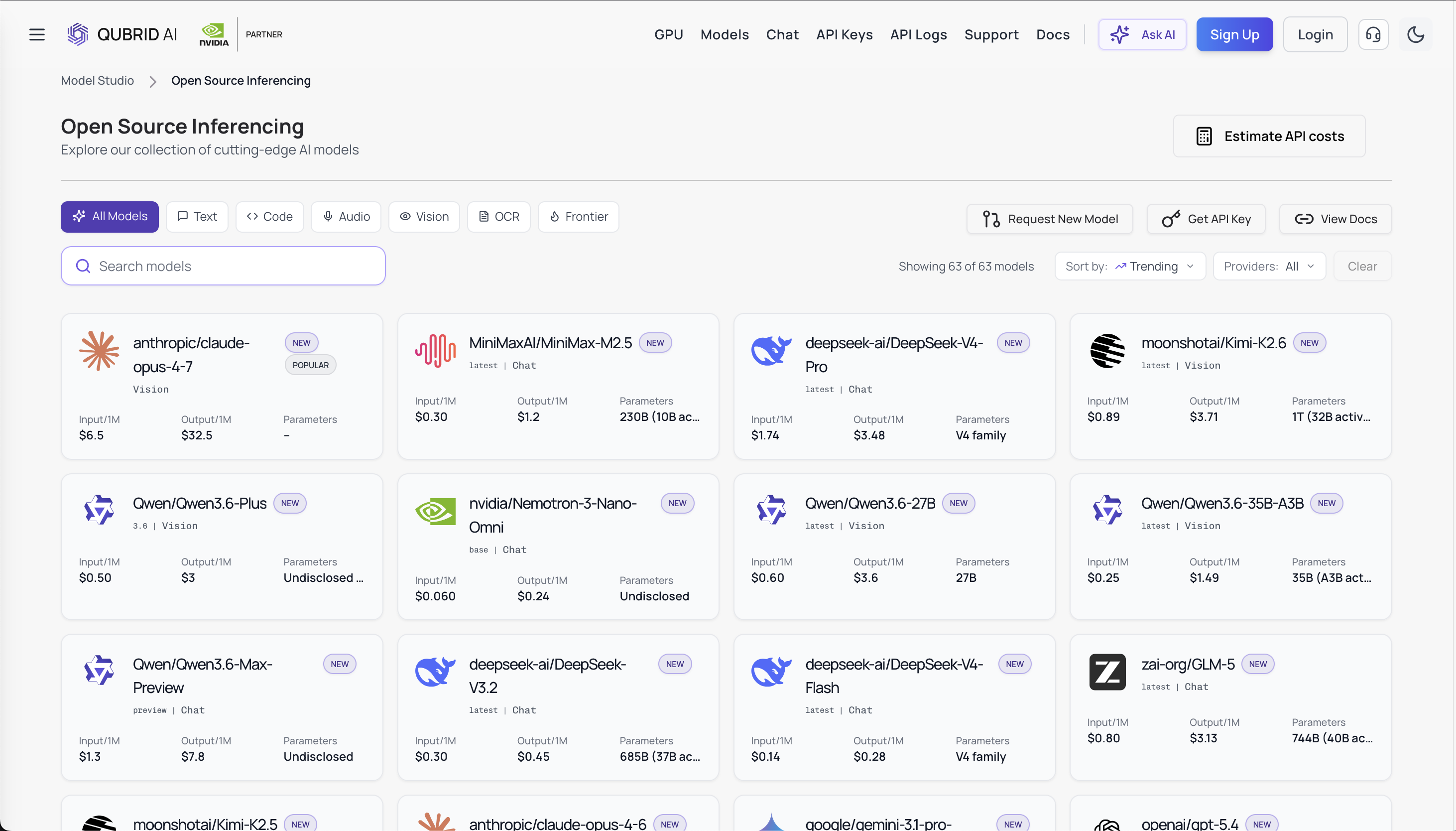
👉 Try both models here: https://platform.qubrid.com/models?provider=NVIDIA
Background: What Is Nemotron Super 120B-A12B-FP8?
Released in March 2026, Nemotron Super is NVIDIA's flagship open reasoning model, purpose-built for demanding multi-agent applications such as software development automation, cybersecurity triage, IT ticket resolution, and complex retrieval-augmented generation (RAG) pipelines. It carries 120 billion total parameters, but activates only 12 billion per forward pass thanks to a novel LatentMoE architecture making it dramatically more compute-efficient than its parameter count suggests.
The FP8 quantized checkpoint is the most inference-optimized variant. On a single NVIDIA B200 or B300 GPU, the entire FP8 model fits without requiring tensor parallelism a significant deployment simplification for enterprise teams. On 8x H100-80GB setups, it runs with standard tensor and expert parallelism configurations.
What sets Super apart architecturally is a combination of three innovations working in tandem. First, LatentMoE routes tokens through a smaller latent dimension before expert computation, achieving better accuracy per byte than standard MoE designs. Second, Mamba-2 selective state-space layers dramatically improve throughput on long-context workloads compared to pure transformer architectures. Third, Multi-Token Prediction (MTP) layers enable native speculative decoding, delivering over 50% higher token generation speed than leading open models at equivalent accuracy.
Nemotron Super was trained across 25 trillion tokens and supports a context window of up to 1 million tokens, outperforming both GPT-OSS-120B and Qwen3.5-122B on the RULER benchmark at 1M context length. In terms of raw inference throughput, it achieves up to 2.2x higher throughput than GPT-OSS-120B and up to 7.5x higher throughput than Qwen3.5-122B on the 8K input / 64K output setting, measured on B200 GPUs.
The trade-off is that Super is a text-only model. It does not process images, audio, or video. It is a specialist in reasoning, coding, tool use, instruction following, and long-context text tasks. For organizations that need pure reasoning horsepower with agentic reliability, it is very hard to beat.
👉 Try Nemotron Super on Qubrid AI: https://platform.qubrid.com/model/nvidia-nemotron-3-super-120b-a12b
What Is Nemotron 3 Nano Omni?
Released on April 28, 2026, Nemotron 3 Nano Omni is NVIDIA's open omni-modal reasoning model a single architecture that unifies text, image, video, and audio understanding. With 30 billion total parameters and only 3 billion active per inference pass, it runs on just 25GB of RAM or VRAM at 4-bit quantization, making it one of the most deployable frontier-class multimodal models ever released as open weights.
The "Omni" designation is not a marketing label. It means that vision tokens, audio tokens, and text tokens all flow through the same model in a single inference pass, activating different subsets of 128 experts depending on what the input requires. There is no separate vision pipeline, no separate speech-to-text model, and no inter-model latency. This is the key distinction from previous multimodal systems that stitched together separate specialist models and passed outputs between them an approach that fragments context and adds latency at every handoff.
The architecture is built on three interlocking components. The language backbone is Nemotron 3 Nano 30B-A3B, featuring 23 Mamba-2 selective state-space layers for efficient long-context processing, 23 MoE layers with 128 experts and top-6 routing, and 6 grouped-query attention layers for global reasoning expressivity. The vision encoder is C-RADIOv4-H, which handles images at native aspect ratio with variable-resolution processing from 512x512 up to 1840x1840. The audio encoder is Parakeet-TDT-0.6B-v2, handling speech, environmental sounds, and long-form audio with varying accents and speakers. Video processing uses a dedicated Conv3D tubelet embedding path that fuses consecutive frame pairs, halving the number of vision tokens the language model must attend to.
On throughput benchmarks, Nano Omni delivers up to 9.2x higher system efficiency for video reasoning tasks and 7.4x higher efficiency for multi-document tasks compared to Qwen3-Omni at the same interactivity threshold. On the MediaPerf benchmark which evaluates models on real production tasks under real cost constraints, not academic test sets Nano Omni achieves the highest throughput across every task category and the lowest inference cost for video-level tagging among all open models tested.
Nano Omni tops six multimodal leaderboards including OCRBench-V2, MMLongBench-DOC, VoiceBench, WorldSense, and DailyOmni. It was specifically trained for agentic computer use, enabling it to interpret GUI environments, screen recordings, and interactive interfaces. Companies already adopting it include Foxconn, Palantir, Docusign, and Oracle.
The model supports a 256K token context window and runs on hardware ranging from NVIDIA Jetson edge devices all the way up to DGX data center clusters, under the NVIDIA Open Model License for commercial use.
👉 Try Nemotron Nano Omni on Qubrid AI: https://platform.qubrid.com/model/nemotron-3-nano-omni
What We Tested on Qubrid AI
We ran a structured comparison on Qubrid AI's inference platform, submitting identical prompts across three task categories: complex reasoning, coding, and multimodal understanding. For the multimodal test, we demonstrated Nano Omni's unique capabilities alongside Super's text-only response to illustrate the core architectural difference clearly.
Test 1: Multi-Step Reasoning
Prompt: "A warehouse has three storage zones. Zone A holds twice as many items as Zone B. Zone C holds 40% fewer items than Zone A. If the total across all zones is 2,400 items, how many items are in each zone, and what percentage of total inventory does each zone represent?"
Nemotron Super 120B resolved this cleanly with a visible reasoning trace, walking through the algebra step by step, catching its own arithmetic when verifying the equations, and presenting a final formatted answer with percentages. Output: 312 tokens. Latency: approximately 140ms. The reasoning was structured, auditable, and correct.
Nemotron 3 Nano Omni also solved the problem correctly but with fewer intermediate reasoning steps shown. Output: 274 tokens. Latency: approximately 195ms. The answer was accurate, but the chain of thought was more compressed.
Winner: Nemotron Super 120B for deep reasoning tasks where step-by-step auditability matters. Nano Omni is capable but produces less detailed reasoning chains.
Test 2: Code Generation with Edge Cases
Prompt: "Write a Python function that takes a list of dictionaries representing transactions, groups them by category, computes the total and average per category, and returns results sorted by total descending. Handle empty input and missing fields gracefully."
Nemotron Super produced clean, well-structured Python with comprehensive docstrings, inline comments explaining the logic, explicit handling for empty lists and missing fields, and a note on time complexity. Output: 487 tokens. The code was production-ready without modification.
Nemotron 3 Nano Omni produced functionally correct code with edge case handling but lighter documentation. Output: 398 tokens. The logic was equivalent; the presentation was leaner.
Winner: Nemotron Super 120B for production code that needs to be reviewed and maintained by teams. Nano Omni for rapid prototyping where documentation is added separately.
Test 3: Multimodal Document Understanding (Nano Omni Exclusive)
Prompt: We submitted a scanned multi-page financial report a PDF with mixed tables and charts and asked: "Summarize the key revenue trends from this document, identify any quarters where growth decelerated, and flag any figures that appear inconsistent."
Nemotron 3 Nano Omni processed the document through its C-RADIOv4-H vision encoder, correctly identified five revenue trend sections across eight quarters, flagged a discrepancy between a chart and the accompanying table in Q3, and produced a concise but thorough summary. The entire response completed in under 4 seconds on Qubrid AI's infrastructure.
Nemotron Super 120B-A12B-FP8 cannot process images or PDFs. For this task, it is simply not applicable which is precisely the point. Organizations running document intelligence workflows, media analysis pipelines, or audio transcription agents need Nano Omni. Super cannot do this at all.
Winner: Nemotron 3 Nano Omni by default. This entire category of workload is outside Super's scope.
Test 4: High-Volume Agentic Tool Use
Prompt: We simulated a 12-step agentic workflow involving sequential tool calls, conditional branching, and state tracking across multiple retrieved documents.
Nemotron Super 120B completed all 12 steps without dropping a tool call or losing state. Its 1M token context window and LatentMoE architecture, optimized for long-horizon agent coherence, maintained task context cleanly across the entire sequence consistent with NVIDIA's published 99.2% tool use reliability figure for multi-step agentic benchmarks.
Nemotron 3 Nano Omni completed 10 of 12 steps correctly but lost a piece of state at step 8 during a particularly long-context segment, requiring a retry. Its 256K context window is generous but shorter than Super's 1M, and its smaller active parameter count means less working memory for deeply nested agent logic.
Winner: Nemotron Super 120B for complex, long-horizon agentic workflows where every step must succeed.
Benchmark Comparison
Benchmark / Metric | Nemotron Super 120B-A12B-FP8 | Nemotron 3 Nano Omni | Winner |
|---|---|---|---|
AIME 2025 (Math Reasoning) | Leading in size class | Capable | Super |
SWE-Bench Verified (Coding) | Leading in size class | Capable | Super |
TerminalBench (Agentic Tasks) | Leading in size class | Capable | Super |
OCRBench-V2 (Document OCR) | N/A (text only) | Top of leaderboard | Nano Omni |
MMLongBench-DOC | N/A (text only) | Top of leaderboard | Nano Omni |
VoiceBench (Audio Understanding) | N/A (text only) | Top of leaderboard | Nano Omni |
WorldSense (Video Reasoning) | N/A (text only) | Top of leaderboard | Nano Omni |
Throughput vs GPT-OSS-120B | Up to 2.2x higher | Up to 9.2x higher (multimodal) | Nano Omni |
Context Window | 1M tokens | 256K tokens | Super |
Min GPU for Deployment | Single B200/B300 (FP8) | ~25GB RAM (4-bit) | Nano Omni |
Modalities Supported | Text and Code | Text, Image, Video, Audio | Nano Omni |
Active Parameters per Pass | 12B | 3B | Nano Omni (efficiency) |
Tool Use Reliability | 99.2% | High, lower at long context | Super |
Long-Context Coherence | Excellent — RULER leader at 1M | Good — 256K limit | Super |
What the Benchmarks Actually Tell Us
The numbers above reveal a pattern that raw benchmark tables often obscure: these two models are not competing for the same job. They are designed for fundamentally different positions within an AI system architecture.
Nemotron Super 120B is the brain. It reasons deeply, holds context across enormous sequences, executes complex multi-step agent workflows reliably, and produces outputs that are auditable and consistent. If you are building a system that needs to plan, reason, and act across long horizons using text and code, Super is the right foundation.
Nemotron 3 Nano Omni is the eyes and ears. It processes the real world as it comes messy documents, audio recordings, video feeds, screenshots and turns perceptual input into structured reasoning. If your system needs to understand what it sees and hears before it can decide what to do, Nano Omni is the right foundation.
NVIDIA themselves position these models as complementary. In a full Nemotron 3 agent stack, Nano Omni typically serves as the multimodal perception sub-agent interpreting inputs from the real world while Super or Ultra serves as the planning and execution backbone that decides what to do with that information.
Choose Nemotron Super 120B-A12B-FP8 If You Are...
Building multi-agent pipelines for software development, code review, or DevOps automation
Running cybersecurity triage, IT ticket automation, or enterprise workflow orchestration
Designing RAG systems that need to reason across hundreds of retrieved documents in a single context
Operating long-horizon agent loops where every step and tool call must succeed without retry
Working with text-only inputs where reasoning depth and context length are the primary constraints
Deploying on B200 or B300 GPUs and want single-GPU FP8 inference without tensor parallelism overhead
Requiring strong multilingual reasoning across English, French, German, Spanish, Japanese, and Chinese
👉 Try Nemotron Super 120B on Qubrid AI: https://platform.qubrid.com/model/nvidia-nemotron-3-super-120b-a12b
Choose Nemotron 3 Nano Omni If You Are...
Building document intelligence pipelines that process PDFs, scanned forms, financial tables, or research papers
Running video understanding workflows for media tagging, content moderation, or surveillance analysis
Processing audio call center recordings, meeting transcriptions, narrated tutorials as part of an agent loop
Building computer-use agents that interpret screen recordings and GUI states in real time
Deploying on edge devices or systems with constrained GPU memory (runs at 25GB on 4-bit)
Building multimodal customer support agents that see what the user sees and hear what the user says
Working in healthcare, media, finance, or ad-tech where inputs arrive in mixed modalities simultaneously
Looking for the highest-throughput open omni model on real production workloads
👉 Try Nemotron 3 Nano Omni on Qubrid AI: https://platform.qubrid.com/model/nemotron-3-nano-omni
Our Verdict
This is not a competition. It is a division of labor.
Nemotron Super 120B-A12B-FP8 is the right model when your problem is fundamentally about reasoning: planning sequences of actions, maintaining state across a long agent loop, coding complex logic, and making auditable decisions over large text corpora. It is the most capable open reasoning model in its class for these workloads, and its FP8 efficiency means you can run it at serious scale without a prohibitive GPU footprint.
Nemotron 3 Nano Omni is the right model when your problem is fundamentally about perception: understanding documents the way a human analyst would, processing a video the way a human reviewer would, hearing audio the way a human listener would. It collapses what used to require three or four separate models and inference pipelines into a single architecture with lower latency, lower cost, and higher throughput than any of its competitors.
The most sophisticated production deployments will use both. Nano Omni handles perception and feeds structured observations to Super, which plans and executes. Together they form the reasoning and perception backbone of a genuinely capable AI agent system and both are fully open, commercially licensed, and available on Qubrid AI today.
You do not have to pick just one upfront. On Qubrid AI, you can run both models in parallel, route different workload types to each, and optimize per use case. That is the future of AI infrastructure not monoculture, but intelligent orchestration.
👉 Explore all Nemotron models on Qubrid AI: https://platform.qubrid.com/models?provider=NVIDIA