Running Open-Source AI Models with NVIDIA’s Inference Stack
From large language models and multimodal reasoning systems to diffusion pipelines for image generation, some of the most rapid innovation in AI is happening in the open.
However, while the models themselves evolve quickly, one challenge remains consistent: running inference efficiently at scale.
Deploying large models in real-world applications introduces practical concerns around latency, throughput, GPU utilization, and cost. This is where modern inference infrastructure - particularly NVIDIA’s GPU and software stack - becomes essential.
Why Inference Infrastructure Matters
Open models give developers and organizations significant flexibility.
Teams can:
fine-tune models on proprietary datasets
deploy models in private or hybrid environments
adopt new research breakthroughs without waiting for vendor APIs
But modern models are computationally heavy.
Running a 70B parameter language model or a high-resolution diffusion pipeline on poorly optimized hardware quickly leads to:
unstable latency
memory bottlenecks
inefficient GPU utilization
unpredictable operational costs
Efficient inference therefore requires more than just GPUs. It requires a well-optimized serving stack designed specifically for AI workloads.
The NVIDIA Inference Stack
NVIDIA has built one of the most widely used ecosystems for deploying deep learning models in production.
The stack typically consists of several key components:
CUDA
CUDA is NVIDIA’s parallel computing platform that enables GPU acceleration for AI workloads. Most modern machine learning frameworks - including PyTorch and TensorFlow - rely on CUDA libraries to execute tensor operations efficiently on GPUs.
TensorRT
TensorRT is NVIDIA’s high-performance inference SDK. It optimizes trained models for deployment through several techniques, including:
mixed precision inference (FP16 / INT8)
kernel auto-tuning
layer fusion
memory optimization
These optimizations can significantly reduce inference latency while improving throughput.
Triton Inference Server
The Triton Inference Server provides a standardized system for serving models in production.
It supports multiple frameworks including:
PyTorch
TensorFlow
ONNX
TensorRT
Triton also introduces several capabilities useful for large-scale deployments:
dynamic batching
concurrent model execution
multi-model hosting
streaming inference support
Together, CUDA, TensorRT, and Triton form a powerful foundation for running AI workloads on NVIDIA GPUs.
Deploying Open-Source Models
A growing number of high-quality models are available through open repositories such as Hugging Face and GitHub.
Examples include:
Meta’s LLaMA family
Mistral AI models
Alibaba’s Qwen series
DeepSeek reasoning models
Stable Diffusion image generation pipelines
Whisper speech recognition models
Each of these models can be deployed on NVIDIA GPU infrastructure using frameworks like PyTorch or ONNX, and then optimized through TensorRT for production inference.
In practice, the deployment workflow often involves:
Loading the model into a supported framework
Converting it to an optimized runtime format
Serving it through Triton or a similar inference server
Scaling GPU resources as traffic increases
Managing this pipeline manually can be complex, especially when running multiple models or supporting production workloads.
From Experimentation to Production
One of the biggest challenges in AI development is bridging the gap between experimentation and real-world deployment.
Researchers and engineers often prototype models locally or in notebooks, but production systems must handle:
concurrent users
autoscaling infrastructure
consistent latency
reliable GPU scheduling
cost monitoring
Modern inference platforms attempt to simplify this process by handling GPU orchestration, model optimization, and scaling automatically.
This allows developers to focus more on building AI features rather than managing infrastructure.
Real-World Use Cases
Efficient inference infrastructure is critical across a wide range of applications.
Some common production use cases include:
Document intelligence systems
Combining OCR models with retrieval-augmented generation (RAG) pipelines to extract and analyze large volumes of documents.
AI automation agents
Systems that combine language models with tools and APIs to automate workflows.
Content moderation
Running high-throughput classification models to filter large streams of user-generated content.
Creative generation
Diffusion models for image or video generation that require high GPU throughput and low latency.
In many of these scenarios, optimized inference pipelines can reduce response times from seconds to milliseconds while significantly lowering compute costs.
The Role of Infrastructure in Open AI
Open-source AI models are advancing extremely quickly. New architectures, training techniques, and reasoning capabilities are appearing at an unprecedented pace.
However, access to models alone is not enough. Production-grade AI systems require infrastructure that can reliably serve those models under real-world workloads.
GPU acceleration, optimized runtimes, and scalable inference servers are essential pieces of that puzzle.
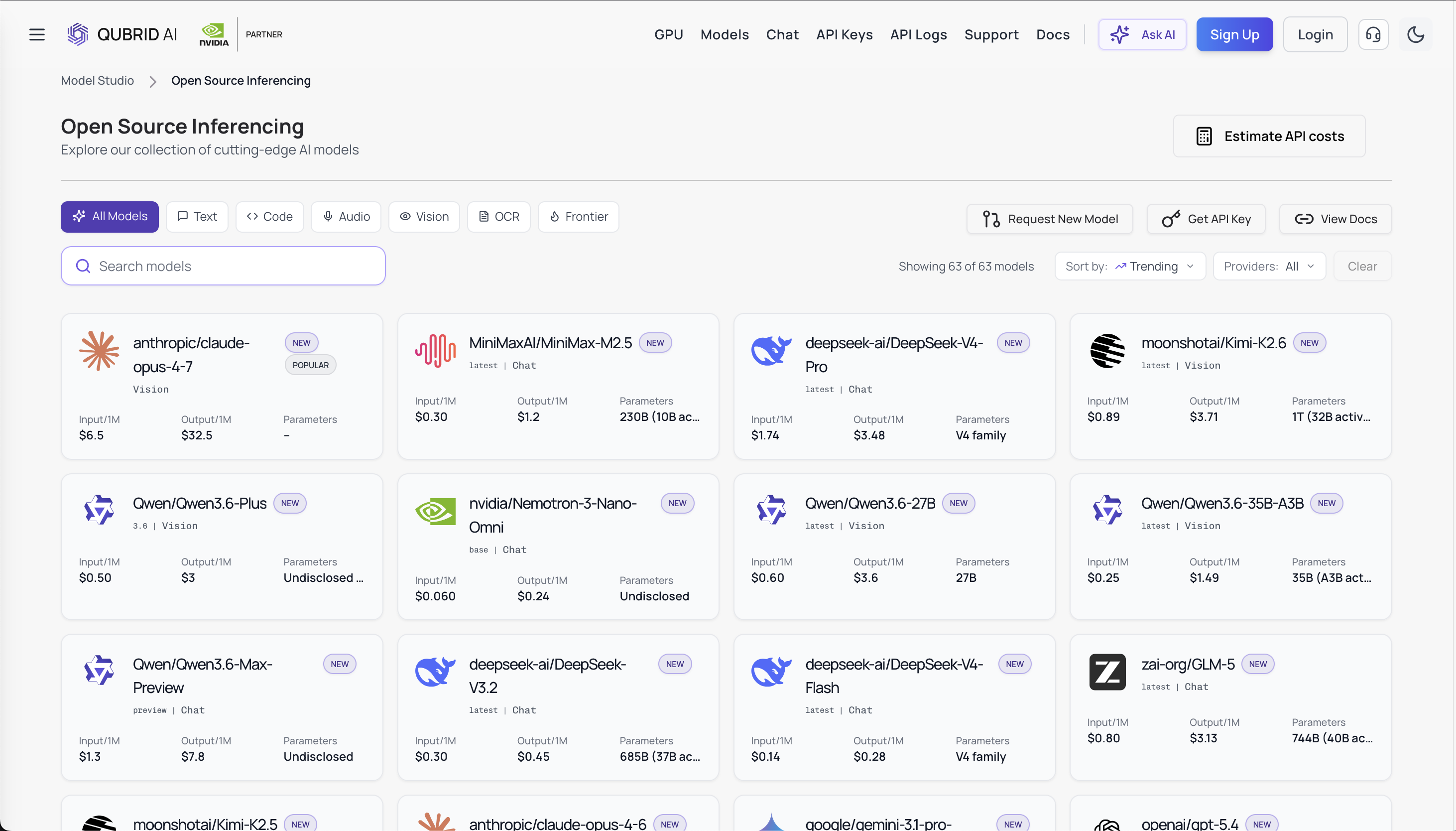
Platforms such as Qubrid AI focus specifically on this layer of the stack by providing managed GPU infrastructure designed for running open-source models in production environments.
You can learn more about the platform here:
https://platform.qubrid.com/models
Final Thoughts
AI innovation increasingly happens in the open. Organizations adopting open-source models gain flexibility, transparency, and control over their AI systems.
But the real value of AI appears when models move from research environments into real applications.
Efficient inference infrastructure - powered by technologies like CUDA, TensorRT, and Triton - plays a critical role in making that transition possible.