Last updated Sep 1, 2026.
GLM-5.3-Flash Pricing: API Cost per 1M Tokens
7 minutes read

Qubrid Team
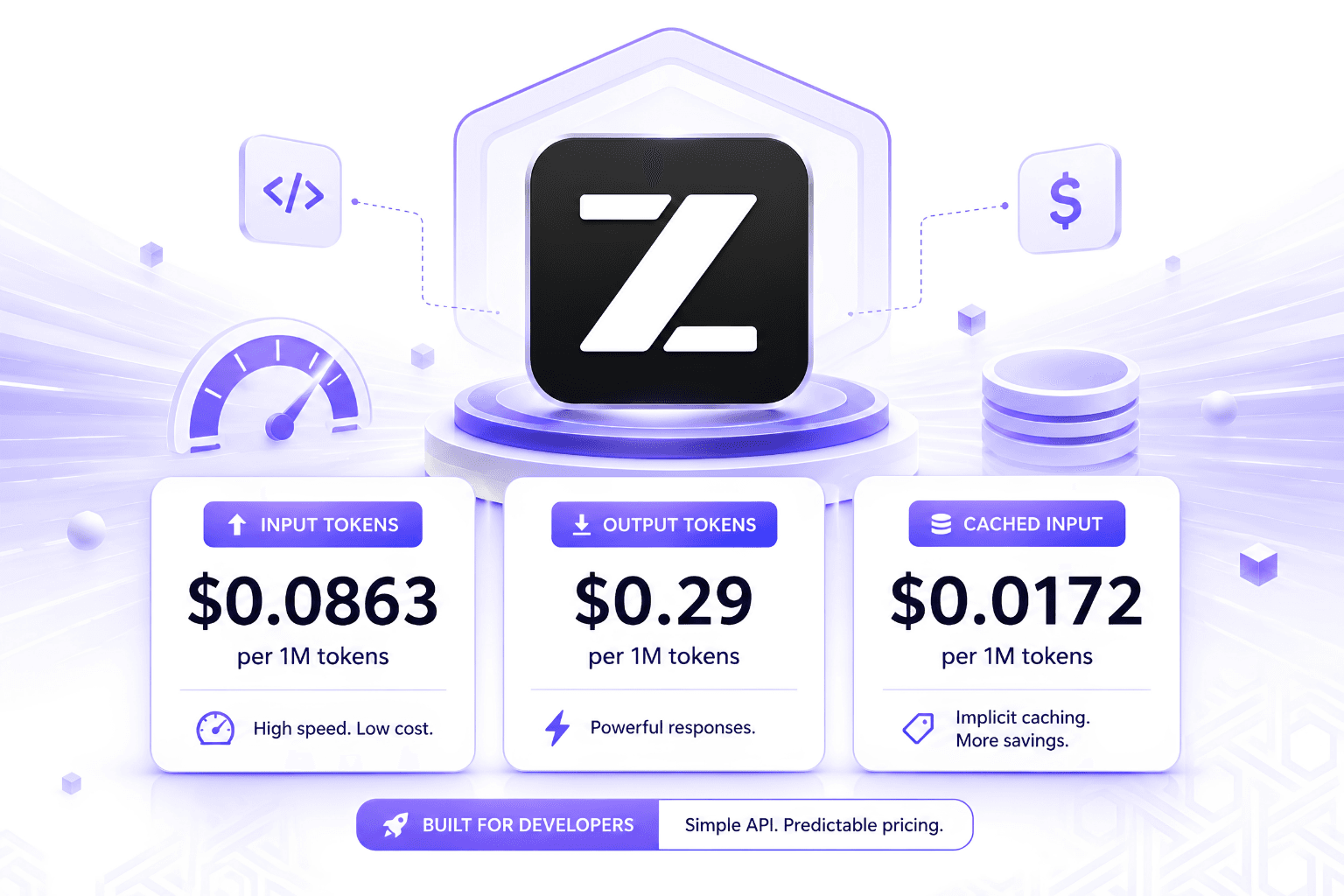
Quick answer: GLM-5.3-Flash costs $0.0863 per 1M input tokens and $0.29 per 1M output tokens on Qubrid AI, with implicit cached input at $0.0172 per 1M tokens. That is a blended rate of roughly $0.058 per 1M tokens at a standard 7:2:1 cache-to-input-to-output ratio. Reasoning tokens bill as output, and thinking cannot be disabled on this model, so reasoning_effort is your main cost control.
GLM-5.3-Flash rate card
Pay-as-you-go, no minimum commitment, no reserved capacity requirement.
Token type | List price | Qubrid price | Savings |
|---|---|---|---|
Input | $0.11 / 1M tokens | $0.0863 / 1M tokens | 20% |
Output | $0.36 / 1M tokens | $0.29 / 1M tokens | 20% |
Implicit cache (input) | $0.0216 / 1M tokens | $0.0172 / 1M tokens | 20% |
Model string: zai-org/GLM-5.3-Flash. Endpoint: https://platform.qubrid.com/v1.
Output is priced at 3.4x input. That ratio, combined with a model that always reasons, is what your bill comes down to.
Monthly cost estimates
Assuming no cache hits, so treat these as ceilings:
Monthly volume | Input cost | Output cost | Total |
|---|---|---|---|
5M in / 1M out | $0.43 | $0.29 | $0.72 |
50M in / 10M out | $4.32 | $2.90 | $7.22 |
250M in / 50M out | $21.58 | $14.50 | $36.08 |
1B in / 200M out | $86.30 | $58.00 | $144.30 |
A billion input tokens a month for under $150 is the number worth sitting with. At this rate GLM-5.3-Flash is cheap enough to put in front of every request rather than reserving for the ones that justify a frontier model.
Why reasoning effort is your largest cost lever
Most reasoning models let you switch thinking off for cheap tasks. GLM-5.3-Flash does not.
As the vLLM Recipes project documents, the generation prompt opens a <think> block unconditionally. There is no enable_thinking: false. Your only control is depth, through three levels:
Mode | How to request | Token cost |
|---|---|---|
Max (default) | Omit | Highest |
High |
| Balanced |
Low |
| Lowest |
Artificial Analysis measured GLM-5.3-Flash generating 150M output tokens across its Intelligence Index, against a 110M median for comparable open-weight models. At $0.29 per 1M output tokens, with reasoning traces billed as output, that multiplier lands on your invoice.
Two behaviours that cost money if you do not know them:
Only
lowandhighare recognised as overrides. The chat template resolves anything else tomax, including typos. Passing"medium", which is not a valid level on this model, silently gives you the most expensive setting.Z.ai's model card recommends keeping
maxfor benchmark reproduction. That is guidance about reproducibility, not production. Do not inherit it by default.
What to set:
Workload | Setting | Effect on cost |
|---|---|---|
Classification, routing, extraction, short summarisation |
| Lowest output spend |
Chat, RAG answering, code completion |
| Bounded reasoning, most of the quality |
Multi-step agents, debugging, repo-level changes |
| The working default for agentic traffic |
Hard one-shot problems, benchmark reproduction |
| Reserve for a fraction of traffic |
How implicit caching changes your real bill
Cached input is billed at $0.0172 instead of $0.0863, a 5x reduction.
Worked example
A coding agent runs a 12-turn session with a 40,000-token system prompt and tool schema that never changes:
Without cache hits: 12 × 40,000 × $0.0863 / 1,000,000 = $0.0414
With cache hits after turn one: (40,000 × $0.0863 + 440,000 × $0.0172) / 1,000,000 = $0.0110
A 73% reduction on the static portion of input spend, before counting the actual conversation.
How to earn cache hits
Put invariant content first: system prompt, tool schemas, few-shot examples, then persistent retrieved documents, then the variable conversation. A single changed token near the start of your prompt invalidates everything after it. This is the cheapest optimisation available and it costs one refactor.
GLM-5.3-Flash vs GLM-5.3 on cost
Both run behind the same Qubrid endpoint, so routing between them is a model string change rather than an integration project.
GLM-5.3-Flash | GLM-5.3 | |
|---|---|---|
Input | $0.0863 / 1M | $1.61 / 1M |
Output | $0.29 / 1M | $5.06 / 1M |
Implicit cache | $0.0172 / 1M | $0.30 / 1M |
Intelligence Index | 57 | 60 |
Roughly 18x cheaper on input and 17x on output, for three points on the Intelligence Index.
At 50M input and 10M output tokens a month, that is about $7.22 on Flash against roughly $131 on the flagship. The routing pattern that works: send the volume to Flash, escalate the hard tail to GLM-5.3 on confidence thresholds or explicit failure. Flash also adds vision, which the flagship does not have.
API versus self-hosting: where break-even sits
GLM-5.3-Flash is MIT licensed, so self-hosting is genuinely unrestricted. The hardware bill is the catch, and for this model it is decisive.
Hardware you would need
Checkpoint | Approximate weight footprint |
|---|---|
FP8 native (default) | ~306 GiB |
roughly double | |
NVFP4 (Blackwell only) | 4-bit MoE experts |
That is before runtime and KV-cache overhead. The vLLM recipe's reference configuration is FP8 with tensor parallelism across four GPUs on a GB200 tray. This is not a workstation deployment, and unlike smaller open models there is no meaningful consumer-hardware path.
Hidden costs the rate card does not show
Operational detail from the vLLM recipe that turns into engineering hours:
FlashInfer 0.6.17 or newer is required for NoPE sparse MLA. Sparse-MLA initialisation errors mean you need 0.6.18 or newer.
--reasoning-parser glm45and--tool-call-parser glm47are mandatory. Without the reasoning parser, the entire thinking block lands inmessage.content, and since thinking cannot be disabled, that is every request.Hopper does not support FP8 KV cache for this model and must run BF16 KV, roughly doubling your cache memory.
AMD Instinct gfx950 works via ROCm, but MTP speculative decoding does not, so you lose the throughput benefit. PR #53906 will add MI300X and MI325X support.
Serving recipes exist for vLLM, SGLang, KTransformers and Unsloth.
The break-even
A workload at 250M input and 50M output tokens a month costs about $36 on the API. A four-GPU GB200 configuration costs orders of magnitude more than that, before engineering time and before you account for idle capacity.
For this model the API is the default answer for almost everyone. Self-hosting makes sense when you have data residency or air-gap requirements, or you already own datacenter-class hardware that needs filling. If that is you, Qubrid also provides on-demand GPU compute and on-premises AI appliances, so the decision does not require changing vendors.
Frequently asked questions
How much does GLM-5.3-Flash cost per 1M tokens? $0.0863 per 1M input tokens and $0.29 per 1M output tokens on Qubrid AI, with implicit cached input at $0.0172 per 1M tokens.
What is the blended price of GLM-5.3-Flash? Roughly $0.058 per 1M tokens at a standard 7:2:1 cache-hit, input, output ratio.
Are reasoning tokens billed separately? No, they bill at the output rate of $0.29 per 1M tokens. Since thinking cannot be disabled on this model, reasoning_effort is the only way to control that spend.
Can I reduce cost by turning off thinking? Not entirely. GLM-5.3-Flash opens a thinking block unconditionally. The lowest-cost setting is reasoning_effort: "low".
How much does cached input cost? $0.0172 per 1M tokens, 5x cheaper than uncached input. On multi-turn agent workloads with a stable prefix this typically removes around three quarters of input spend.
Is GLM-5.3-Flash cheaper than GLM-5.3? Substantially. About 18x cheaper on input and 17x on output, for a three-point difference on the Artificial Analysis Intelligence Index.
Is there a free tier for GLM-5.3-Flash? Qubrid is pay-as-you-go with no minimum commitment, so you can evaluate at whatever volume your test needs. The weights are also MIT licensed if you prefer to run it yourself at hardware cost.
Is the API cheaper than self-hosting GLM-5.3-Flash? For almost everyone, yes. The FP8 checkpoint is roughly 306 GiB and the reference deployment uses four GPUs on a GB200 tray, against about $36 a month for a 250M-input workload on the API.
What hardware do I need to run GLM-5.3-Flash locally? About 306 GiB for the FP8 checkpoint before runtime and KV-cache overhead, roughly double for BF16. There is no practical consumer-hardware path for this model.
Does the price change with context length? No. The rate is flat. Longer prompts cost more because they contain more tokens, not because of a tier change.
Start building
zai-org/GLM-5.3-Flash is live on Qubrid AI at $0.0863 per 1M input tokens.
Generate an API key at platform.qubrid.com
Point your OpenAI SDK at
https://platform.qubrid.com/v1Set
model="zai-org/GLM-5.3-Flash"Set
reasoning_effortbefore you scale
Qubrid AI serves 60+ open-source models behind one OpenAI-compatible API, alongside on-demand GPU compute and on-premises appliances.