
Last updated Sep 1, 2026.
GLM-5.3-Flash: Benchmarks, API Pricing, and the Complete Developer Guide
23 minutes read

Qubrid Team
Quick answer: GLM-5.3-Flash is a 320B-total, 18B-active multimodal mixture-of-experts model released under the MIT license on August 26, 2026. It scores 57 on the Artificial Analysis Intelligence Index, three points behind the far larger GLM-5.3, and 84.3 on Terminal-Bench 2.1. On Qubrid AI it costs $0.0863 per 1M input tokens and $0.29 per 1M output tokens, callable through an OpenAI-compatible endpoint with the model string zai-org/GLM-5.3-Flash.
What GLM-5.3-Flash is, and the Ox Alpha stealth launch
Most models launch with a blog post. This one launched by being used.
On August 20, 2026 an unattributed model appeared on third-party AI platforms under the codename Ox Alpha, free to use, with a million-token context window and tool calling enabled. Developers hammered it for a week without knowing who had built it. As TechNode reported, Zhipu identified Ox Alpha as GLM-5.3-Flash on August 26 and released the weights the following day.
That sequence matters more than it might appear. A large developer population formed an opinion about this model's quality before knowing the vendor, the parameter count, or the price. It is close to a blind taste test, and the model came out of it with a reputation rather than a launch announcement. It also meant independent benchmark verification landed within days rather than weeks, because the model was already in everyone's hands.
As the Z.ai team writes on the model card, GLM-5.3-Flash is the first natively multimodal model in the GLM-5 series. Their claim: with 320B total parameters and just 18B active, it outperforms GLM-5.2 across benchmarks and real-world workloads at one-tenth the price, while approaching Claude Opus 4.8 on coding and agentic benchmarks.
Specifications at a glance
Property | Value |
|---|---|
Model string |
|
Architecture | Sparse MoE, 320B total / 18B active per token |
Layers | 45 |
Experts | 8 of 288 routed per token |
Attention | Hybrid KDA linear + NoPE sparse MLA |
Speculative decoding | One MTP draft layer in the checkpoint |
Context window | 1,048,576 tokens declared in the checkpoint |
Modalities | Text, image, video |
Default checkpoint precision | FP8 |
License | MIT |
Released | August 26, 2026 |
Pre-training corpus | 30T multimodal tokens |
Adoption backs up the stealth-launch reputation. The model card shows over 441,000 downloads in the first month, 79 community quantizations, 11 fine-tunes, one adapter, one merge and 36 active discussion threads. Five Hugging Face Spaces were built on it inside the first week.
Architecture, and what the terminology actually means
GLM-5.3-Flash introduces several things at once, and the launch coverage tends to list the acronyms without explaining why any of them matter. Here is what each one buys you.
Hybrid linear and sparse attention
This is the first GLM model to combine linear and sparse attention, and it is the reason the economics work.
As the vLLM Recipes project documents, the 45-layer language model combines KDA linear-attention layers with NoPE sparse MLA layers, routes each token through 8 of 288 experts, and supports image and video inputs.
The practical difference: a standard attention layer keeps a KV cache that grows with every token in the conversation, so memory and cost climb as context lengthens. A linear-attention layer carries a constant-size recurrent state instead. Put most of your layers on linear attention and long context stops being expensive.
Z.ai describes the hybrid design as sharply reducing long-context serving costs while preserving precise long-context capabilities. That is a vendor claim without independent audit, but it is the kind of claim that shows up in your bill if true, and the pricing suggests it is.
Mixture of experts, 320B total and 18B active
The model has 320 billion parameters but only activates about 18 billion for any given token, routing through 8 of 288 experts. You get the knowledge capacity of a very large model at roughly the inference compute of a small one.
The catch, which matters only if you self-host: routing means later tokens may select different experts, so the deployment still needs the entire checkpoint in memory. Reduced compute, not reduced storage.
Manifold-Constrained Hyper-Connections
Z.ai credits mHC with improving scaling efficiency during training. This is an architecture-and-training decision rather than something you tune at inference time, and it has not been independently evaluated. Worth knowing the term exists; not worth acting on.
Multi-Token Prediction
GLM-5.3-Flash includes one MTP draft layer in the checkpoint. A cheaper mechanism predicts several tokens ahead and the main model verifies them in a single pass, raising throughput without changing output quality. The vLLM reference configuration runs five speculative tokens:
--speculative-config '{"method":"mtp","num_speculative_tokens":5}'This is one of the levers a serving platform pulls to keep latency down on a model this size. As an API consumer you get the benefit without configuring anything.
A context-window discrepancy worth knowing about
The checkpoint declares 1,048,576 tokens and the vLLM recipe confirms it. But Z.ai's own benchmark footnotes describe evaluating NL2Repo under 1M context and DeepSWE under 400K, and Artificial Analysis lists the model's context window as 400K based on served deployments.
The weights support a million tokens. What any given deployment serves depends on configuration, because KV cache demand scales with both context length and concurrency. If you have a genuine long-context workload, test it against real inputs rather than trusting the specification number.
Framework support
Serving recipes shipped quickly and broadly: vLLM, SGLang, KTransformers, Transformers and Unsloth. This is not a model that will be under-supported.
Official benchmarks from Z.ai
From the model card. Read the methodology notes after the table before quoting any of these.
Benchmark | GLM-5.3-Flash | GLM-5.2 |
|---|---|---|
Terminal-Bench 2.1 | 84.3 | - |
DeepSWE v1.1 (Pass@1) | 63.4 | 46.2 |
AutomationBench v1.0.6 | 48.8 | 26.2 |
GDPval-AA v2 | 1773 | 1504 |
Humanity's Last Exam (with tools) | 55.3 | - |
Agent's Last Exam | 26.3 | - |
The generational jumps are large. DeepSWE moves from 46.2 to 63.4. AutomationBench nearly doubles, 26.2 to 48.8. GDPval-AA v2 rises from 1504 to 1773.
Terminal-Bench 2.1 at 84.3 is the number that travelled. As DataCamp noted in its analysis, that places it near Claude Opus 4.8 at 85.0 and behind GPT-5.6 Terra at 87.4. On AutomationBench the 48.8 is a clear lead over Opus 4.8 at 41.0 and DeepSeek-V4-Vision-Exp at 38.8, the largest margin over Opus on any benchmark in the set.
Methodology notes you should actually read
The model card is unusually specific about how each number was produced, and honest reporting means passing that along:
Terminal-Bench 2.1 was evaluated inside the Claude Code harness, version 2.1.207, at temperature 1.0 with a 6-hour timeout and 65,536 max new tokens. Harness choice materially affects agentic scores, and this is not a neutral one.
Humanity's Last Exam with tools used GPT-5.6-luna (medium) as the judge model, with a 163,840-token maximum generation length and 300,000-token context under a context-management strategy. LLM-as-judge introduces its own variance.
DeepSWE ran under the mini-swe-agent harness at temperature 0.95, top_p 1.0, 400K context, 6-hour timeout.
NL2Repo used both rule-based and LLM-based judgement to block unauthorised pip and curl operations, specifically to prevent reward hacking.
AutomationBench was v1.0.6, incorporating the null-type handling fix from PR #13. The number is not comparable across versions.
BabyVision resized images so the shorter side is at least 1.5K pixels, matched to other baselines.
GDPval-AA v2 was evaluated by Artificial Analysis, not Z.ai. That row is independent.
Z.ai Code Bench is an in-house evaluation. The Claude Opus 4.8 coding parity claim rests on it and cannot be reproduced externally.
None of this makes the numbers wrong. It means vendor benchmarks stay vendor benchmarks until someone else runs them.
Independent benchmarks and what they confirm
Someone else did run them, and fast.
Artificial Analysis scored GLM-5.3-Flash at 57 on the Intelligence Index, a composite covering reasoning, knowledge, mathematics and coding. Among open-weight models of similar size, the median is 29.
The comparison that matters is internal. GLM-5.3 scores 60 on the same index.
Model | Intelligence Index | Cost per task |
|---|---|---|
GLM-5.3 (max) | 60 | $0.68 |
GLM-5.3-Flash (max) | 57 | $0.09 |
Three index points for roughly a seventh of the cost per task. As Artificial Analysis wrote at release, that places GLM-5.3-Flash in line with GPT-5.6 Terra and Muse Spark 1.2, sitting comfortably on the Pareto frontier for intelligence versus cost per task.
Independent verification landing within days of a launch is rare, and it happened here for a specific reason: the model had already been in thousands of developers' hands for a week under a different name.
The verbosity measurement
Artificial Analysis also recorded GLM-5.3-Flash generating 150M output tokens across the Intelligence Index, against a 110M median for comparable open-weight models. Somewhat above average rather than extreme, but it compounds, because thinking cannot be disabled on this model and reasoning traces bill as output tokens.
Structured extraction, measured separately
The model card carries LlamaIndex ExtractBench results, run as one-shot structured output from files. This is the most actionable table on the page for anyone building a document pipeline, and it is the one launch coverage keeps flattening into a single number.
ExtractBench split | Score |
|---|---|
Mean | 80.75 |
Short documents | 96.30 |
Medium documents | 51.56 |
A 45-point gap between short and medium is not noise. GLM-5.3-Flash is close to excellent at extracting structured data from short documents and roughly coin-flip on medium ones.
The mean of 80.75 tells you almost nothing useful. The split tells you exactly what to build.
The reasoning setting you cannot turn off
Every model has one configuration detail that decides your bill. On GLM-5.3-Flash it is this: thinking is always on.
As the vLLM recipe puts it, the generation prompt opens a <think> block unconditionally. There is no enable_thinking: false. What you get instead is three depth levels through reasoning_effort:
Mode | How to request | Behaviour |
|---|---|---|
Max (default) | Omit | Deepest reasoning. Hard maths, multi-step planning, agentic tasks. Highest token cost. |
High |
| Balanced depth and latency. |
Low |
| Lightest reasoning. Simple Q&A, lowest latency and token cost. |
Two behaviours that will cost you money if you do not know them:
Only
lowandhighare recognised as overrides. The chat template resolves anything else tomax, including typos, and including"medium", which is not a valid level on this model. If you are migrating from a model that usesmedium, you will silently land on the most expensive setting with no error.The resolved level is injected into the system prompt as
Reasoning Effort: Low|High|Max, so it consumes a small amount of prompt budget and is visible to the model.
Z.ai's own guidance is to keep the default max for benchmark and leaderboard reproduction. That is a statement about reproducibility, not about production traffic.
What to set:
Workload | Setting |
|---|---|
Classification, routing, extraction, short summarisation |
|
Chat, RAG answering, code completion |
|
Multi-step agents, debugging, repo-level changes |
|
Hard one-shot problems, benchmark reproduction |
|
One more chat-template detail: clear_thinking defaults to false. Z.ai recommends explicitly passing clear_thinking=true for chat scenarios.
GLM-5.3-Flash pricing on Qubrid AI
Pay-as-you-go, no minimum commitment, no reserved capacity requirement.
Token type | List price | Qubrid price | Savings |
|---|---|---|---|
Input | $0.11 / 1M tokens | $0.0863 / 1M tokens | 20% |
Output | $0.36 / 1M tokens | $0.29 / 1M tokens | 20% |
Implicit cache (input) | $0.0216 / 1M tokens | $0.0172 / 1M tokens | 20% |
At a standard 7:2:1 cache-hit, input, output ratio, that works out to a blended rate of roughly $0.058 per 1M tokens.
Monthly cost estimates
Assuming no cache hits, so treat these as ceilings:
Monthly volume | Input cost | Output cost | Total |
|---|---|---|---|
5M in / 1M out | $0.43 | $0.29 | $0.72 |
50M in / 10M out | $4.32 | $2.90 | $7.22 |
250M in / 50M out | $21.58 | $14.50 | $36.08 |
1B in / 200M out | $86.30 | $58.00 | $144.30 |
A billion input tokens a month for under $150 is the number worth sitting with. At this rate GLM-5.3-Flash is cheap enough to put in front of every request rather than reserving for the ones that justify a frontier model. That changes architecture decisions, not just budgets: classification, routing, enrichment and pre-processing steps that were previously too expensive to run on a capable model become viable.
How implicit caching changes your real bill
Cached input is billed at $0.0172 instead of $0.0863, a 5x reduction.
Worked example. A coding agent runs a 12-turn session with a 40,000-token system prompt and tool schema that never changes:
Without cache hits: 12 × 40,000 × $0.0863 / 1,000,000 = $0.0414
With cache hits after turn one: (40,000 × $0.0863 + 440,000 × $0.0172) / 1,000,000 = $0.0110
A 73% reduction on the static portion of input spend, before counting the actual conversation.
How to structure prompts for cache hits
Order matters, because a single changed token near the start invalidates everything after it. Put content in descending order of stability:
System prompt and role instructions
Tool and function schemas
Few-shot examples
Retrieved documents that persist across the session
Conversation history
The current user message
The common mistake is injecting a timestamp, session ID or user name into the system prompt. That single variable token at position one means you never get a cache hit for the entire session. Move it to the end of the prompt or into the user message.
Reasoning tokens are output tokens
Output is priced at 3.4x input. Reasoning traces bill as output. Artificial Analysis measured 150M output tokens across its index against a 110M median. Set reasoning_effort before you scale, and remember that an invalid value silently reverts you to max.
Calling the GLM-5.3-Flash API on Qubrid AI
The endpoint is OpenAI-compatible. An existing OpenAI SDK integration needs three changes: base URL, API key, model string.
Basic text completion
from openai import OpenAI

# Initialize the OpenAI client with Qubrid base URL
client = OpenAI(
    base_url="https://platform.qubrid.com/v1",
    api_key="QUBRID_API_KEY",
)

response = client.chat.completions.create(
    # Must match the exact model ID from the docs - variations will cause errors.
    model="zai-org/GLM-5.3-Flash",
    messages=[
        {
            "role": "user",
            "content": "Explain the main benefits of using a chat completion API for text generation."
        }
    ],
    max_tokens=4096,
    temperature=1,
    top_p=1,
    stream=False
)

print(response.choices[0].message.content)
The model string is zai-org/GLM-5.3-Flash exactly as written. Case and the organisation prefix both matter.
Controlling reasoning effort
response = client.chat.completions.create(
    model="zai-org/GLM-5.3-Flash",
    messages=messages,
    max_tokens=4096,
    extra_body={
        "chat_template_kwargs": {
            "reasoning_effort": "low",   # low | high | max
        }
    },
)
Chat scenarios
extra_body={
    "chat_template_kwargs": {
        "reasoning_effort": "low",
        "clear_thinking": True,
    }
}
Vision input
messages = [
    {
        "role": "user",
        "content": [
            {
                "type": "image_url",
                "image_url": {"url": "https://your-domain.com/invoice-scan.png"}
            },
            {
                "type": "text",
                "text": "Extract every line item as JSON with description, quantity, and unit price."
            }
        ]
    }
]

response = client.chat.completions.create(
    model="zai-org/GLM-5.3-Flash",
    messages=messages,
    max_tokens=2048,
)
Video input
messages = [
    {
        "role": "user",
        "content": [
            {
                "type": "video_url",
                "video_url": {"url": "https://your-domain.com/walkthrough.mp4"}
            },
            {
                "type": "text",
                "text": "Summarise the key steps demonstrated in this recording."
            }
        ]
    }
]
As the vLLM recipe explains, the chat template expands each into <|begin_of_image|> or <|begin_of_video|> placeholder tokens, and the same image token is reused for video frames, with frame spans delimited by the video start and end tokens.
Streaming with separated reasoning
Thinking is always on, so handling the reasoning field is mandatory rather than optional. Skip it and chain-of-thought text surfaces to your users.
reasoning_content = ""
answer_content = ""
is_answering = False

for chunk in completion:
    if not chunk.choices:
        if chunk.usage:
            print("Usage:", chunk.usage)
        continue

    delta = chunk.choices[0].delta

    if getattr(delta, "reasoning_content", None):
        reasoning_content += delta.reasoning_content
    elif getattr(delta, "reasoning", None):
        reasoning_content += delta.reasoning

    if getattr(delta, "content", None):
        if not is_answering:
            is_answering = True
        answer_content += delta.content
Tool calling
Tool calling was enabled during the Ox Alpha trial week and is a core capability rather than an afterthought. Standard OpenAI syntax applies:
response = client.chat.completions.create(
    model="zai-org/GLM-5.3-Flash",
    messages=messages,
    tools=tools,
    tool_choice="auto",
    max_tokens=4096,
    extra_body={"chat_template_kwargs": {"reasoning_effort": "high"}},
)
For agentic loops, high is the working default. The AutomationBench and DeepSWE results are where this model is strongest, and those are tool-mediated workloads.
Recommended sampling parameters
Z.ai publishes evaluation settings per benchmark rather than one recommended profile:
Scenario | temperature | top_p |
|---|---|---|
General use, HLE evaluation | 1.0 | 0.95 |
Long-context code generation (NL2Repo) | 1.0 | 1.0 |
Agentic coding (DeepSWE) | 0.95 | 1.0 |
Vision (BabyVision) | 1.0 | 0.95 |
Structured output and document extraction
The ExtractBench spread makes this a specific recommendation rather than a general one.
Strong fit: invoices, receipts, purchase orders, forms, ID documents, single-page records, screenshots to schema. The 96.30 short-document score plus native vision plus $0.0863 input pricing is a hard combination to beat for high-volume document pipelines.
Test carefully: multi-page contracts, long reports, dense financial filings. The 51.56 medium-document score says accuracy falls off as documents grow, and that is a workload characteristic rather than something you prompt around. Chunk long documents into shorter units before extraction.
response = client.chat.completions.create(
    model="zai-org/GLM-5.3-Flash",
    messages=[{
        "role": "user",
        "content": [
            {"type": "image_url", "image_url": {"url": document_url}},
            {"type": "text", "text": "Return JSON matching this schema: " + schema}
        ]
    }],
    temperature=1,
    top_p=1,
    max_tokens=2048,
    extra_body={"chat_template_kwargs": {"reasoning_effort": "low"}},
)
Extraction is where low effort costs you least. The task is perception and formatting, not deliberation.
Where GLM-5.3-Flash fits, and where it does not
Strong fits
High-volume agentic coding. The AutomationBench lead over Claude Opus 4.8, the DeepSWE jump to 63.4 and Terminal-Bench at 84.3 all point the same direction. Combined with the price, this is the clearest use case.
Document extraction at scale. Short-form documents specifically. Native vision plus 96.30 on the ExtractBench short split plus sub-cent-per-thousand-documents economics.
Classification, routing and enrichment. At $0.0863 per million input tokens you can afford to run a capable model on every inbound record rather than a cheap classifier plus escalation logic.
RAG answering over long context. The hybrid attention design exists precisely to make long context affordable to serve.
Multimodal pipelines. Text, image and video through one endpoint and one model, rather than three services stitched together.
Weaker fits
The hardest reasoning problems. Three index points behind GLM-5.3 is small, but at the frontier those three points concentrate in exactly the problems you would reach for a flagship to solve. Route the hard tail upward.
Long-document extraction. Covered above. Chunk first, or use a different approach.
Latency-critical single requests. Thinking cannot be disabled, so there is a floor on time-to-answer even at low effort. If you need sub-second responses on simple queries, this is not the model.
Local or edge deployment. The FP8 checkpoint is roughly 306 GiB. There is no consumer-hardware path here, unlike smaller open-weight models.
Hardware requirements and self-hosting reality
GLM-5.3-Flash is MIT licensed, so self-hosting is genuinely unrestricted. The hardware bill is the catch.
Checkpoint | Approximate weight footprint |
|---|---|
FP8 native (default) | ~306 GiB |
roughly double | |
NVFP4 (Blackwell only) | 4-bit MoE experts |
That is before runtime and KV-cache overhead. The vLLM recipe's reference configuration is FP8 with tensor parallelism across four GPUs on a GB200 tray. This is datacenter-scale infrastructure.
Operational details worth reading before you commit:
FlashInfer 0.6.17 or newer is required for NoPE sparse MLA. If you hit a sparse-MLA initialisation error, the troubleshooting note specifies 0.6.18 or newer.
--reasoning-parser glm45and--tool-call-parser glm47are the correct parsers. Without the reasoning parser, the entire thinking block lands inmessage.content, and since thinking cannot be disabled, that is every single request.Hopper does not support FP8 KV cache for this model and must run BF16 KV, roughly doubling cache memory. Blackwell can use
--kv-cache-dtype fp8.AMD Instinct gfx950 is supported via ROCm, but MTP speculative decoding is not available on that image, so you lose the throughput benefit. PR #53906 will add MI300X and MI325X support.
At TP=4 the FP8 checkpoint reports a 14.92M-token KV pool and roughly 113x max concurrency at 128K context, against 8.87M for BF16 at the same settings.
Prefill/decode disaggregation is supported on a single 8-GPU node, bridged by NIXL KV transfer, with KDA conv-state and KV-cache layouts pinned identically on both pools.
The break-even
At $0.0863 input and $0.29 output, a workload running 250M input and 50M output tokens a month costs about $36 on the API. A four-GPU GB200 configuration costs orders of magnitude more, before engineering time and before idle capacity.
For this model the API is the default answer for almost everyone. Self-hosting makes sense when you have data residency or air-gap requirements, or you already own datacenter-class hardware that needs filling. If that is you, Qubrid also provides on-demand GPU compute and on-premises AI appliances, so the decision does not require changing vendors.
GLM-5.3-Flash vs GLM-5.3
Both are available on Qubrid, and the capability gap is much narrower than the price gap.
GLM-5.3-Flash | GLM-5.3 | |
|---|---|---|
Architecture | 320B total / 18B active MoE | Larger MoE flagship |
AA Intelligence Index | 57 | 60 |
AA cost per task | $0.09 | $0.68 |
Modalities | Text, image, video | Text |
Qubrid input price | $0.0863 / 1M | $1.61 / 1M |
Qubrid output price | $0.29 / 1M | $5.06 / 1M |
Qubrid cache price | $0.0172 / 1M | $0.30 / 1M |
License | MIT | Open weights |
Best for | High-volume agentic work, vision, extraction | Hardest reasoning, deepest coding, long-horizon tasks |
Three index points for roughly 18x the input price. At 50M input and 10M output tokens a month that is about $7.22 on Flash against roughly $131 on the flagship.
The routing pattern that works: send the volume to Flash at low or high effort, escalate the hard tail to GLM-5.3 on confidence thresholds or explicit failure. Both sit behind the same OpenAI-compatible endpoint on Qubrid, so that routing is a model string change rather than an integration project. Flash also adds vision, which the flagship does not have, so for multimodal work it is not a downgrade at all.
Migrating an existing integration
Three changes to get running:
Base URL to
https://platform.qubrid.com/v1API key to your Qubrid key
Model string to
zai-org/GLM-5.3-Flash
Then five things before you scale:
Set
reasoning_effortexplicitly. You inheritmaxby omission. If you are coming from a model that usesmedium, note that it is not valid here and falls back tomaxsilently.Handle the reasoning delta field. Thinking cannot be disabled, so this is mandatory.
Move variable content out of your system prompt. Timestamps and session IDs at position one destroy your cache hit rate.
Set sampling parameters deliberately rather than inheriting framework defaults tuned for other models.
Chunk long documents before extraction, per the ExtractBench split.
Troubleshooting
Reasoning text appearing in user-facing output. Thinking is always on and cannot be disabled. Read delta.reasoning_content separately from delta.content. Self-hosting, this is the missing --reasoning-parser glm45.
reasoning_effort seems to be ignored. Only low and high are recognised as overrides. Any other value, including a typo or "medium", silently resolves to max.
Model not found. The string is zai-org/GLM-5.3-Flash, with the organisation prefix and exact casing.
Responses truncating mid-reasoning. At max effort the reasoning trace can consume your entire max_tokens before the answer starts. Lower the effort or raise the budget.
Cache hit rate near zero. Something variable is near the start of your prompt. Check for injected timestamps, session identifiers or user names in the system message.
Extraction accuracy dropping on longer documents. This is the ExtractBench pattern, not a configuration error. Split long documents into shorter units.
Sparse-MLA initialisation error when self-hosting. Verify your image contains FlashInfer 0.6.18 or newer.
Tool calls not parsing when self-hosting. Use --tool-call-parser glm47 with --enable-auto-tool-choice.
Frequently asked questions
What is GLM-5.3-Flash? A 320B-total, 18B-active multimodal mixture-of-experts model from Z.ai, released August 26, 2026 under the MIT license. It supports text, image and video input and was tested anonymously as "Ox Alpha" before its reveal.
How much does the GLM-5.3-Flash API cost? On Qubrid AI, $0.0863 per 1M input tokens and $0.29 per 1M output tokens, with implicit cached input at $0.0172 per 1M tokens. That is a blended rate of roughly $0.058 per 1M tokens.
What is GLM-5.3-Flash's Intelligence Index score? 57 on the Artificial Analysis Intelligence Index at max reasoning effort, three points behind GLM-5.3 at 60, against a median of 29 for open-weight models of similar size.
What does GLM-5.3-Flash score on Terminal-Bench? 84.3 on Terminal-Bench 2.1, evaluated in the Claude Code harness. That is near Claude Opus 4.8 at 85.0 and behind GPT-5.6 Terra at 87.4.
What does GLM-5.3-Flash score on DeepSWE? 63.4 Pass@1 on DeepSWE v1.1, up from 46.2 for GLM-5.2, run under the mini-swe-agent harness with 400K context.
Is GLM-5.3-Flash open source? Yes, under the MIT license, which permits unrestricted commercial use, modification, fine-tuning and redistribution.
What was the Ox Alpha model? Ox Alpha was the anonymous codename GLM-5.3-Flash was tested under from August 20, 2026, before Zhipu confirmed its identity on August 26 and released the weights.
Can I turn off thinking on GLM-5.3-Flash? No. The generation prompt opens a <think> block unconditionally. You can only reduce depth with reasoning_effort: "low".
What reasoning effort levels does GLM-5.3-Flash support? Three: low, high and max, defaulting to max. There is no medium, and passing one silently falls back to max.
What is the GLM-5.3-Flash context length? The checkpoint declares 1,048,576 tokens. Served deployments vary and Artificial Analysis lists 400K based on what is actually served. Test your real workload.
Does GLM-5.3-Flash support vision? Yes, natively. Image and video input through standard OpenAI content-block syntax. It is the first natively multimodal model in the GLM-5 series.
Does GLM-5.3-Flash support tool calling? Yes, using standard OpenAI tool syntax. Tool use is one of its strongest areas, with 48.8 on AutomationBench against 41.0 for Claude Opus 4.8.
How does GLM-5.3-Flash compare to GLM-5.3? 57 versus 60 on the Intelligence Index, at roughly an eighteenth of the input price on Qubrid. Flash also adds vision, which GLM-5.3 does not have.
Is GLM-5.3-Flash cheaper than GLM-5.3? Substantially. About 18x cheaper on input and 17x on output, for a three-point difference on the Intelligence Index.
What hardware do I need to run GLM-5.3-Flash locally? About 306 GiB for the FP8 checkpoint before runtime and KV-cache overhead, roughly double for BF16. The reference vLLM configuration uses four GPUs on a GB200 tray. There is no practical consumer-hardware path.
Is the API cheaper than self-hosting GLM-5.3-Flash? For almost everyone, yes. A 250M-input workload costs about $36 a month on the API against datacenter-class hardware plus engineering time.
Is GLM-5.3-Flash good at document extraction? Very good on short documents, scoring 96.30 on the ExtractBench short split. Noticeably weaker on medium-length documents at 51.56. Chunk long documents before extraction.
Are GLM-5.3-Flash's benchmarks independently verified? Partly, and faster than usual. The Artificial Analysis Intelligence Index score and the GDPval-AA v2 result are independent, as is ExtractBench. Terminal-Bench, DeepSWE and NL2Repo were run by Z.ai in specific harnesses, and Z.ai Code Bench is in-house.
How many output tokens does GLM-5.3-Flash generate? Artificial Analysis measured 150M across its Intelligence Index, against a 110M median for comparable open-weight models.
Can I fine-tune GLM-5.3-Flash? Yes. The MIT license permits it, and 11 fine-tunes plus an adapter and a merge already exist on Hugging Face.
Does the price change with context length? No. The rate is flat. Longer prompts cost more because they contain more tokens, not because of a tier change.
Get started
zai-org/GLM-5.3-Flash is live now on the Qubrid AI platform at $0.0863 per 1M input tokens.
Create an account and generate an API key at platform.qubrid.com
Point your existing OpenAI SDK at
https://platform.qubrid.com/v1Set
model="zai-org/GLM-5.3-Flash"Set
reasoning_effortbefore you scale
Qubrid AI serves 60+ open-source models behind a single OpenAI-compatible API, alongside on-demand GPU compute and on-premises AI appliances for teams that need to own the hardware.
Related posts
View all posts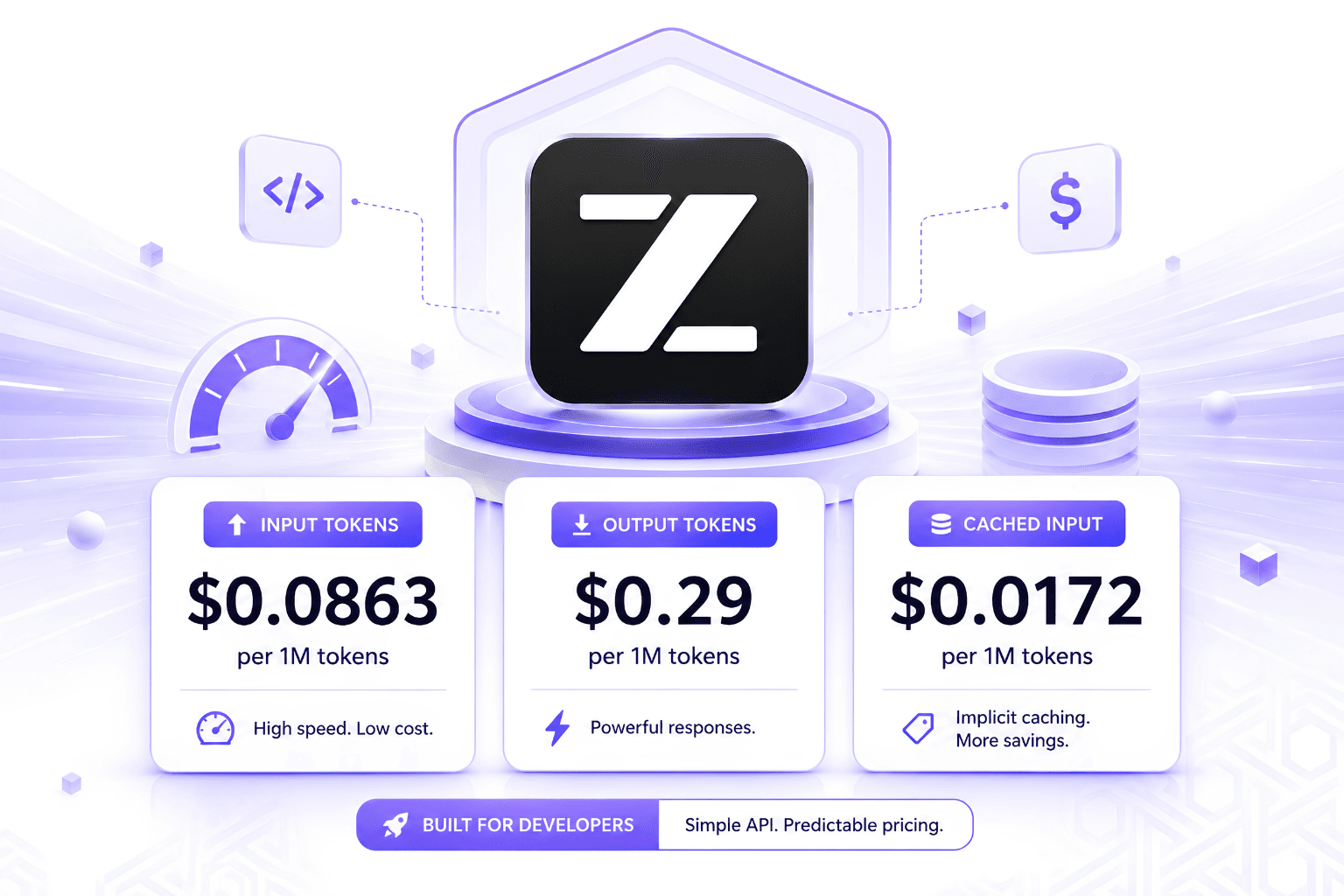
GLM-5.3-Flash Pricing: API Cost per 1M Tokens
GLM-5.3-Flash costs $0.0863 per 1M input tokens and $0.29 per 1M output on Qubrid AI. Cache pricing, reasoning-token cost math, and self-hosting break-even
 Qubrid Team
GLM-5.3-Flash Benchmarks: Official and Independent Results
Every published GLM-5.3-Flash benchmark: Terminal-Bench 84.3, DeepSWE 63.4, Artificial Analysis Intelligence Index 57, ExtractBench, and methodology caveats
Qubrid Team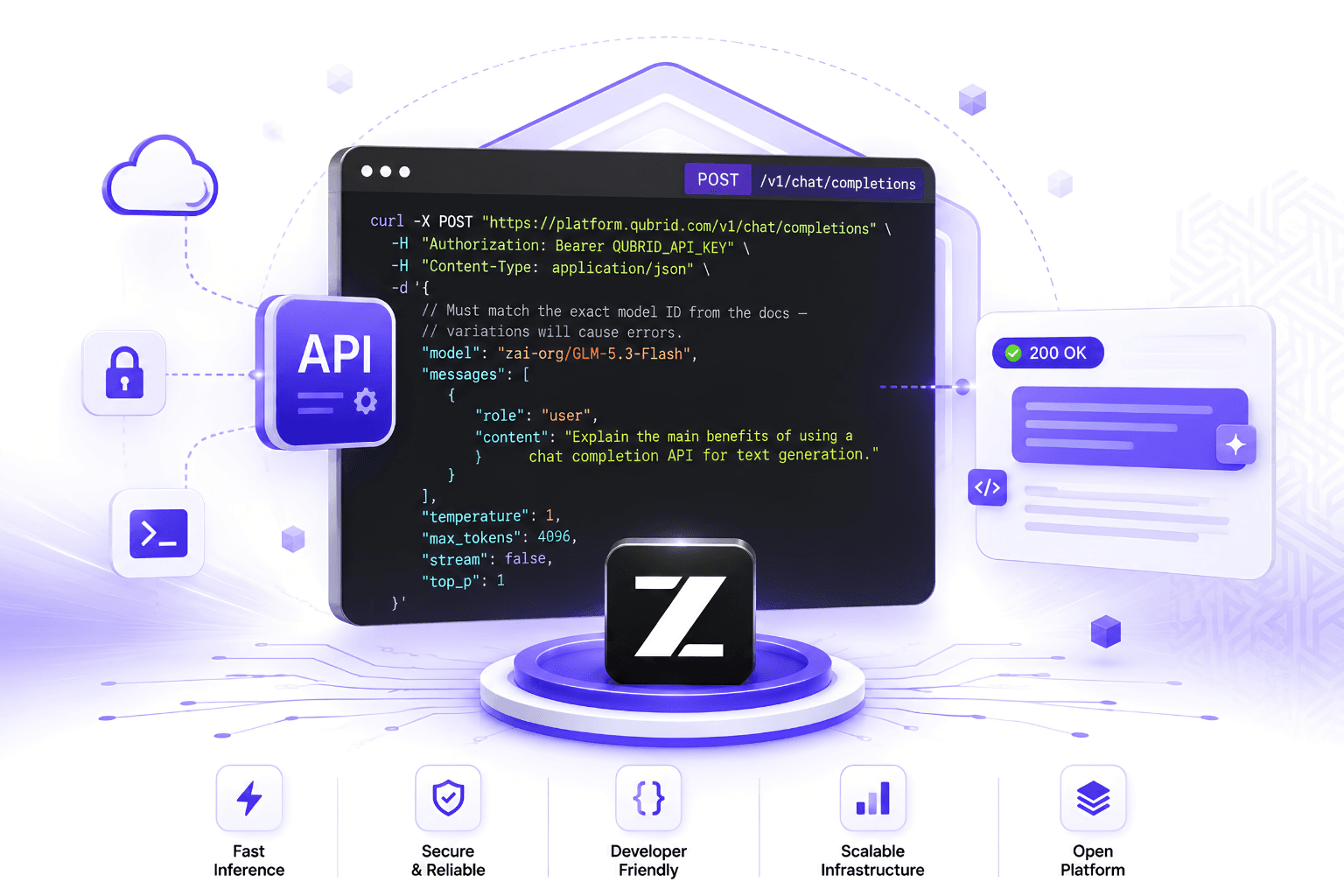
GLM-5.3-Flash API: The Complete Developer Guide
Call the GLM-5.3-Flash API on Qubrid AI's OpenAI-compatible endpoint. Setup, reasoning_effort control, vision and video input, streaming, and troubleshooting
Qubrid Team