The Best Open-Source LLMs for Coding in 2026: A Qubrid AI Guide
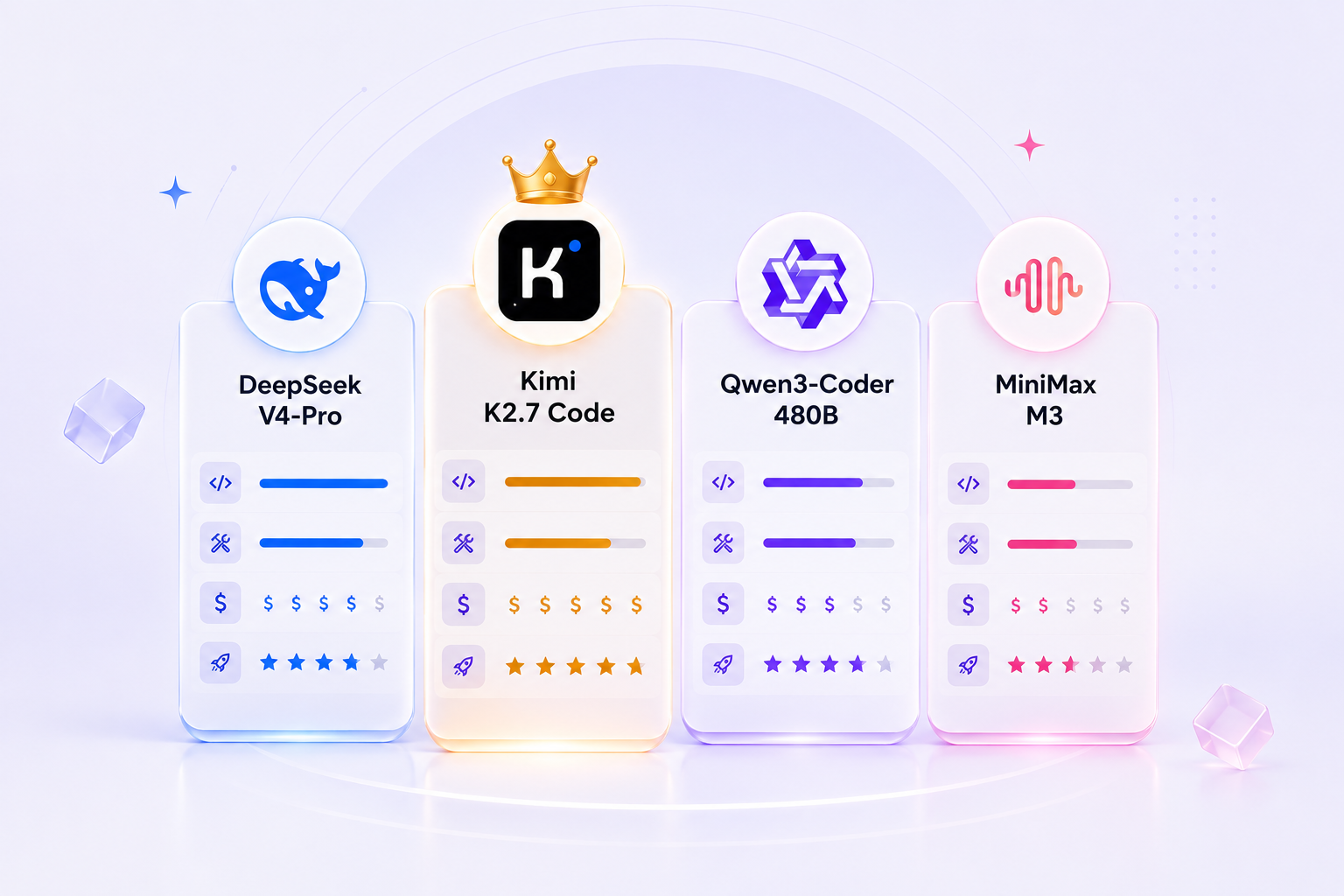
The open-source coding model landscape has changed more in the first half of 2026 than in the entire prior year. Kimi K2.7 Code - released just four days ago on June 12, 2026 - is the first open-weight model to beat Claude Opus 4.8 on MCP tool-use accuracy. DeepSeek V4-Pro matches Gemini 3.1 Pro on SWE-Bench Verified at roughly one-thirtieth the per-token cost. Qwen3-Coder-480B holds the top open-source position on the Scale AI SWE-Bench Pro public leaderboard. MiniMax M3 brings multimodal vision into the coding stack at $0.30/M input. And the Qwen3.7 family delivers vision-capable coding at sub-$0.50 input pricing.
All of them are available on Qubrid today through a single OpenAI-compatible API, running on NVIDIA-accelerated datacenter GPU infrastructure.
This is our honest guide to every coding-capable open-source model on Qubrid as of June 2026 - what the benchmarks actually say, what the real Qubrid prices are, and which model belongs in your pipeline.
Methodology note. Every benchmark figure in this guide comes from vendor-published model cards, the Scale AI SWE-Bench Pro public leaderboard, the Qwen3-Coder-Next technical report (arXiv:2603.00729), or Artificial Analysis. Where a score is vendor-reported only, we label it. Where independent verification does not yet exist for a newly released model, we say that too. Pricing reflects Qubrid platform rates as of June 16, 2026, inclusive of current promotional discounts.
How we think about coding benchmarks
No single number tells you whether a model will work on your codebase. The benchmarks that discriminate meaningfully in 2026 fall into four categories.
SWE-Bench Verified is the industry standard for repository-level software engineering. A model receives a real GitHub issue and a codebase and must produce a patch that passes the associated test suite. The "Verified" subset has human-confirmed ground truth. It is the closest publicly available proxy for "can this model actually fix bugs in production code?" Scores are frequently vendor-reported at launch; the Scale AI SWE-Bench Pro leaderboard provides independent third-party verification under standardized harness conditions and is meaningfully harder than the Verified subset.
Terminal-Bench 2.0 measures autonomous terminal execution over a 3-hour window with 32 CPUs and 48GB RAM. It tests end-to-end shell-based agentic task completion - not single-turn code generation. A model that writes syntactically correct Python but cannot navigate a real Unix environment, run tests, and iterate on failures will score poorly here.
LiveCodeBench tests competitive programming and function-level code generation across a rolling window of LeetCode, Codeforces, and AtCoder problems. It measures pure code-writing quality independent of agentic scaffolding.
MCP Mark Verified measures tool-invocation accuracy through the Model Context Protocol - the standard integration layer used by Claude Code, Cursor, OpenCode, and most production agent harnesses. As agentic coding becomes the dominant use case, accuracy here predicts production reliability more directly than any other benchmark.
We use all four throughout this guide and label the source for every number.
Model comparison at a glance
All prices below are Qubrid platform rates as of June 16, 2026, inclusive of current discounts. Where a model has tiered pricing, the base tier is shown - see the per-model section for the full tier breakdown.
Model | Parameters | Context | SWE-Bench Verified | Input $/1M | Output $/1M | License |
|---|---|---|---|---|---|---|
Kimi K2.7 Code | 1T / 32B active | 262K | Pending (K2.6: 80.2%) | $0.95 | $4.00 | Modified MIT |
DeepSeek V4-Pro | 1.6T / 49B active | 393K (Qubrid) | 80.6% (vendor) | $1.65 | $3.30 | MIT |
DeepSeek V4-Flash | 284B / 13B active | 393K (Qubrid) | 79.0% (vendor) | $0.14 | $0.28 | MIT |
Qwen3-Coder-480B-A35B | 480B / 35B active | 262K | ~72%+ (vendor) | $1.50 | $7.50 | Apache 2.0 |
Qwen3-Coder-Next | 79.7B / 3B active | 262K | - | $0.30 | $1.50 | Apache 2.0 |
Qwen3.7 Max | Undisclosed | 128K | - | $2.50 | $7.50 | Proprietary |
Qwen3.7 Plus | Undisclosed | 256K | - | $0.40 | $1.60 | Proprietary |
MiniMax M3 | MiniMax-M3 arch | 512K | - | $0.30 | $1.20 | Proprietary |
Scale AI SWE-Bench Pro scores where referenced are from the public leaderboard at labs.scale.com/leaderboard/swe_bench_pro_public, verified June 16, 2026. DeepSeek V4-Pro context shown is 393,216 tokens as served on Qubrid. Kimi K2.7 Code SWE-Bench submission is pending as of publication date. Qwen3-Coder-480B pricing shown is for the ≤32K input tier; see per-model section for full tiered breakdown.
Kimi K2.7 Code
Released: June 12, 2026 · License: Modified MIT · Context: 262,144 tokens · Provider: Moonshot AI · Parameters: 1T total / 32B active
Qubrid pricing (20% off):
Price per 1M tokens | |
|---|---|
Input | $0.95 |
Cached input | $0.19 |
Output | $4.00 |
What it is
Kimi K2.7 Code is Moonshot AI's coding-focused successor to K2.6, released four days before this post. It keeps the same 1-trillion-parameter Mixture-of-Experts backbone (384 experts, 8 selected per token) but is trained specifically for long-horizon agentic software engineering. The headline architectural improvement: approximately 30% fewer reasoning tokens consumed per task compared to K2.6, while improving on every benchmark Moonshot has published.
That 30% efficiency gain matters more than it sounds. Reasoning tokens bill as output tokens on every API - including Qubrid. Agentic coding runs that fire hundreds of plan-execute-verify loops pay the thinking cost at every step. A 30% cut compounds across a 300-step agent session in a way that a benchmark percentage point does not.
The model is natively multimodal: text, image, and video input share a single prompt, which means documentation screenshots, architecture diagrams, and recorded bug reproductions can go into the same context as code.
Benchmarks
Moonshot published six benchmark comparisons at launch. K2.7 Code ran in Kimi Code CLI (temperature 1.0, top-p 0.95, 262K context); GPT-5.5 ran in Codex xhigh; Claude Opus 4.8 ran in Claude Code xhigh. All figures below are vendor-reported from the official model card. As of June 15, 2026, no results had been submitted to SWE-Bench Verified, SWE-Bench Pro, LiveCodeBench, or Terminal-Bench 2.0 - the four independent benchmarks in this guide.
Benchmark | K2.7 Code | K2.6 | Change | GPT-5.5 | Claude Opus 4.8 |
|---|---|---|---|---|---|
Kimi Code Bench v2 (vendor) | 62.0 | 50.9 | +21.8% | 69.0 | 67.4 |
Program Bench (vendor) | - | - | +11.0% | - | - |
MLS Bench Lite (vendor) | 35.1 | - | +31.5% | 35.5 | 42.8 |
MCP Mark Verified (vendor) | 81.1 | ~73 | ~+10% | 74.3 | 76.4 |
Kimi Claw 24/7 Bench (vendor) | - | - | ~+10% | - | - |
MCP Atlas (vendor) | - | - | ~+10% | - | - |
The most significant number here is MCP Mark Verified: 81.1, which exceeds both GPT-5.5 (74.3) and Claude Opus 4.8 (76.4). MCP Mark Verified tests correct tool invocation through the Model Context Protocol - CI checks, ticket updates, file edits, database queries - in one continuous loop. For teams building MCP-integrated pipelines, this is the benchmark that most directly predicts whether a model will work reliably in production.
On MLS Bench Lite, K2.7 Code (35.1) is within 0.4 points of GPT-5.5 (35.5) - a near-tie at a fraction of the cost.
Important caveat. Kimi Code Bench v2, Program Bench, MLS Bench Lite, and Kimi Claw 24/7 Bench are proprietary suites designed and administered by Moonshot. Independent SWE-Bench and Terminal-Bench results are pending. K2.6 reached 80.2% on SWE-Bench Verified and 58.6 on SWE-Bench Pro - if K2.7 Code's internal gains translate even partially to those benchmarks, it will meaningfully pressure the closed frontier. That is an extrapolation; treat these numbers as directional until third-party results land.
Who should use Kimi K2.7 Code?
Teams already running K2.6 in production - the upgrade is a one-line model ID change, same pricing, and the 30% thinking-token reduction is immediately bankable on high-volume loops. Teams building MCP-integrated agent pipelines where the 81.1 MCP Mark Verified score is the most relevant signal. Cost-sensitive teams who need open weights under a commercially permissive Modified MIT license.
Tradeoffs to know
The 262K context window trails DeepSeek V4 (393K on Qubrid) and MiniMax M3 (512K). For whole-monorepo in-context work, that gap is real.
No independent SWE-Bench or Terminal-Bench result yet. Run your own task-specific eval before committing K2.7 Code to a new pipeline.
Thinking mode is always on.
tool_choiceis restricted toautoornonewhen thinking is active; any other value returns an error. Multi-step tool loops must retain fullreasoning_contentfrom each prior assistant turn, which inflates prompt cost on long conversations.The built-in
$web_searchtool is incompatible with thinking mode, requiring mode switches for retrieval steps in hybrid pipelines.
DeepSeek V4-Pro
Released: April 24, 2026 · License: MIT (open weights on Hugging Face) · Context: 393,216 tokens · Provider: DeepSeek · Parameters: V4 family
Qubrid pricing (20% off):
Price per 1M tokens | |
|---|---|
Input | $1.65 |
Cached input | $0.14 |
Output | $3.30 |
What it is
DeepSeek V4-Pro is a 1.6-trillion-parameter Mixture-of-Experts model (49B active per token) that introduced two architectural changes enabling 1M-token context: token-wise compression and DeepSeek Sparse Attention (DSA). On Qubrid, it serves at 393,216 tokens of context. The model exposes both OpenAI-compatible and Anthropic-compatible endpoints, and supports Thinking and Non-Thinking modes - making it a drop-in replacement for teams currently using either API format.
The price story is what elevated V4-Pro to the most-deployed frontier-class open-weight model in production: DeepSeek made a 75% price reduction permanent on May 22, 2026. The result is a model that reaches 80.6% on SWE-Bench Verified - tied with Gemini 3.1 Pro - at roughly one-thirtieth the per-output-token cost of closed frontier models.
Benchmarks
Benchmark | DeepSeek V4-Pro | Source |
|---|---|---|
SWE-Bench Verified | 80.6% | Vendor (model card) |
SWE-Bench Pro | 55.4 | Hugging Face model card; Scale AI leaderboard |
GPQA Diamond | 90.1% | Hugging Face model card |
GSM8K | 92.6% | Hugging Face model card |
SWE-Bench Multilingual | 76.2% | Vendor |
Terminal-Bench 2.0 | 67.9% | Vendor |
LiveCodeBench | 93.5 | Vendor |
The SWE-Bench Verified score of 80.6% is independently corroborated via the Hugging Face model card and tied with Gemini 3.1 Pro on that benchmark. The Scale AI SWE-Bench Pro figure (55.4) provides the independently standardized picture: it trails GPT-5.4 (57.7 on SWE-Bench Pro) but does so at an order-of-magnitude lower cost.
On Terminal-Bench 2.0, the vendor reports 67.9% - placing it between Claude Opus 4.6 (65.4%) and Gemini 3.1 Pro (68.5%). LiveCodeBench at 93.5 is a strong function-level coding signal, though this remains vendor-reported pending independent Artificial Analysis tracking.
The cached input price is the operational multiplier that changes cost math for agentic loops: at $0.14/M on a cache hit (versus $1.65 on a miss), system prompts, codebase stubs, and tool definitions that repeat on every agent turn become nearly free after the first request.
Who should use DeepSeek V4-Pro?
Teams running complex agent workflows, deep codebase analysis, or multi-step reasoning where near-frontier quality is required and closed-frontier pricing is not justifiable. The MIT license removes all fine-tuning friction. Teams migrating off legacy deepseek-chat or deepseek-reasoner endpoints (which retire July 24, 2026) should update to the deepseek-v4-pro model string explicitly.
Tradeoffs to know
deepseek-chatanddeepseek-reasonerlegacy endpoint names currently route to V4-Flash, not V4-Pro. Verify your model string before assuming you are running V4-Pro.SimpleQA-Verified at 57.9% lags behind Gemini 3.1 Pro (75.6%) in the vendor comparison. Factual-recall-heavy workflows - version-specific API syntax, CLI argument lookup - should validate this gap on domain tasks.
Max Effort mode is slower than V4-Flash. Pipelines that fire many sequential tool calls will notice the wall-clock difference. For throughput-sensitive loops, consider V4-Flash with fallback to V4-Pro on complex subtasks.
DeepSeek V4-Flash
Released: April 24, 2026 · License: MIT (open weights on Hugging Face) · Context: 393,216 tokens · Provider: DeepSeek · Parameters: V4 family
Qubrid pricing (20% off):
Price per 1M tokens | |
|---|---|
Input | $0.14 |
Cached input | $0.028 |
Output | $0.28 |
What it is
DeepSeek V4-Flash is the throughput and cost tier in the V4 family: 284B total parameters, 13B active per token, same 1M-token context architecture as V4-Pro (served at 393K on Qubrid), same dual API format, same dual-mode thinking. At $0.28/M output, it is the lowest-priced model in this guide.
V4-Flash's benchmark scores closely track V4-Pro at a fraction of the cost: 79.0% SWE-Bench Verified versus V4-Pro's 80.6%, and LiveCodeBench of 91.6 versus 93.5. The gap opens on complex multi-step agentic tasks, where the 13B active parameters versus V4-Pro's 49B active produces an 11-point Terminal-Bench 2.0 difference (56.9% vs 67.9%).
Benchmarks
Benchmark | DeepSeek V4-Flash | DeepSeek V4-Pro | Source |
|---|---|---|---|
SWE-Bench Verified | 79.0% | 80.6% | Vendor |
GPQA Diamond | 88.5% | 90.1% | Vendor |
LiveCodeBench | 91.6 | 93.5 | Vendor |
Terminal-Bench 2.0 | 56.9% | 67.9% | Vendor |
The 11-point Terminal-Bench 2.0 gap is the clearest signal for workload routing: if your pipeline runs end-to-end autonomous terminal execution with many dependent tool calls, use V4-Pro. If your pipeline is batch processing, retrieval, RAG, or single-turn code generation at scale, V4-Flash at $0.28/M output is the right call.
Who should use DeepSeek V4-Flash?
High-volume coding pipelines where per-token cost is the binding constraint. Batch processing, eval runs, and RAG systems. Teams who want 393K context at the lowest available price on Qubrid. Inner-loop model in a multi-model architecture where a smaller fast model handles simple tasks and escalates to V4-Pro or K2.7 Code for complex ones.
Tradeoffs to know
The 11-point Terminal-Bench gap versus V4-Pro is real. Validate on your task distribution before replacing V4-Pro with V4-Flash on agent pipelines.
deepseek-chatcurrently routes here by default in some legacy integration setups. Confirm model strings.Cache hits on Qubrid price at $0.028/M - useful for systems that repeatedly send the same large context.
Qwen3-Coder-480B-A35B
Released: 2025 (continued updates through 2026) · License: Apache 2.0 · Context: 262K tokens · Provider: Alibaba (Cloud) · Parameters: 480B total / 35B active
Qubrid pricing (20% off, tiered by input length):
Context tier | Input $/1M | Cached $/1M | Output $/1M |
|---|---|---|---|
≤ 32K tokens | $1.50 | $1.50 | $7.50 |
32K–128K tokens | $2.70 | $2.70 | $13.50 |
128K–256K tokens | $4.50 | $4.50 | $22.50 |
256K–1M tokens | $9.00 | $9.00 | $90.00 |
What it is
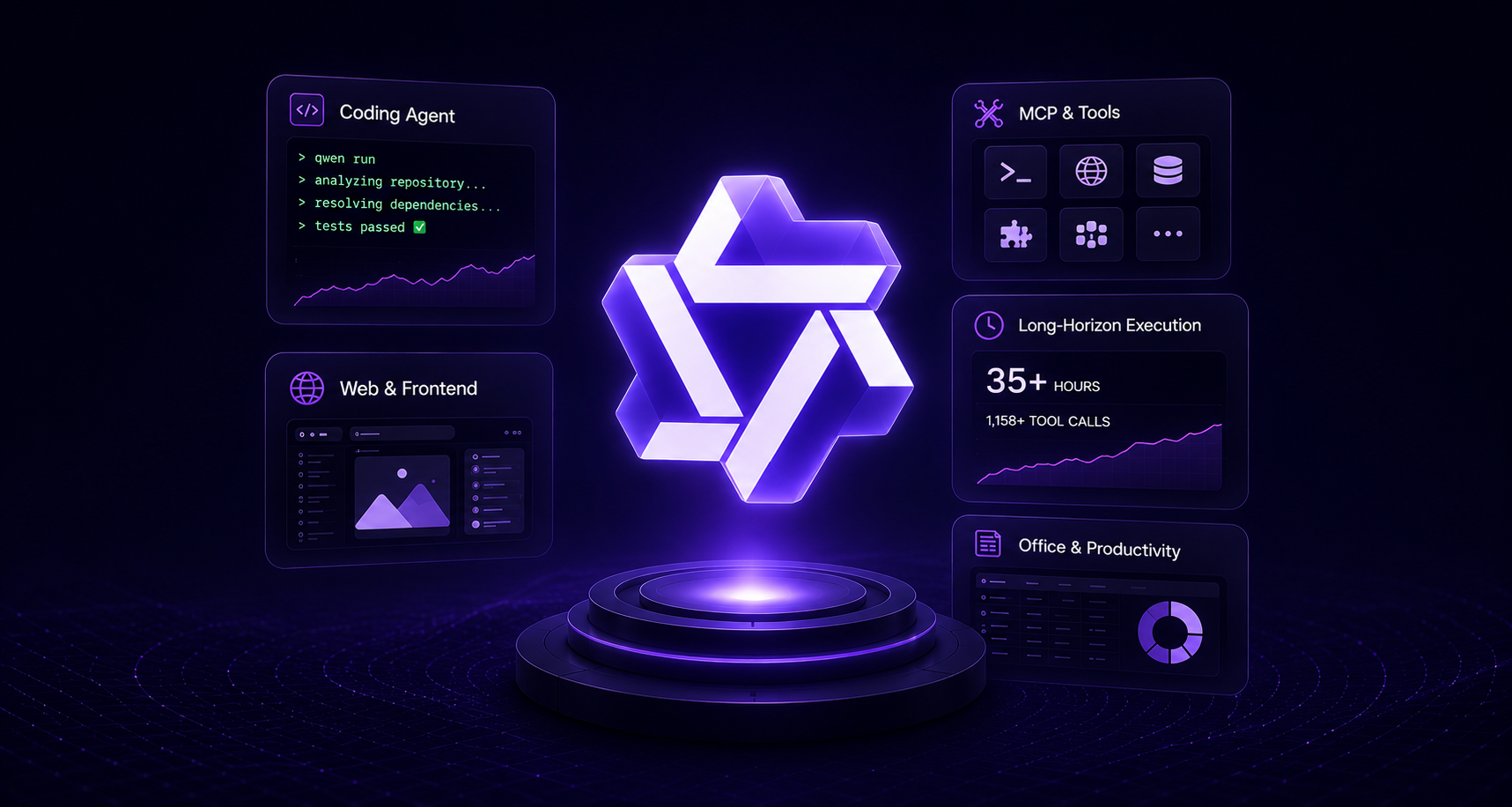
Qwen3-Coder-480B-A35B is Alibaba's flagship open-weight coding model, trained with long-horizon Agent RL across 20,000 parallel environments using Alibaba Cloud infrastructure. It is the most independently benchmarked open-weight coding model in this guide: it holds a verified position on the Scale AI SWE-Bench Pro public leaderboard, tested under standardized third-party conditions.
The Apache 2.0 license is the most permissive in this guide for commercial use, modification, and redistribution - fine-tuning on proprietary codebases has zero license friction.
Benchmarks
Benchmark | Qwen3-Coder-480B | Source |
|---|---|---|
SWE-Bench Pro | 38.70 (±3.55) | Scale AI public leaderboard (independent) |
LiveCodeBench v6 | 44.93 / 51.79 (thinking) | Qwen3-Coder-Next tech report (arXiv:2603.00729) |
EvalPlus | 86.66 | Qwen3-Coder-Next tech report |
MultiPL-E | 88.00 | Qwen3-Coder-Next tech report |
CRUXEval | 92.13 | Qwen3-Coder-Next tech report |
Codeforces Rating | 1800 | Qwen3-Coder-Next tech report |
The Scale AI SWE-Bench Pro score of 38.70 places Qwen3-Coder-480B 6th on the public leaderboard across all models (open and closed), above MiniMax-M2.1 (36.81), gemini-3-flash (34.63), GPT-5.2 (29.94), and every other open-source model in the table. This is the number to anchor to when comparing open-source coding capability under controlled conditions.
Alibaba also reports a vendor SWE-Bench Verified score above 70% using their internal agent scaffold. The Scale AI Pro figure (38.70) and the vendor Verified figure (>70%) are both real; the difference reflects scaffold and harness variance, a well-documented phenomenon in SWE-Bench evaluations. For cross-model comparison, the Scale AI leaderboard is the standardized reference.
Who should use Qwen3-Coder-480B-A35B?
Teams that want the most rigorously third-party-verified open-weight coding model available. Enterprises with Apache 2.0 fine-tuning requirements. Research teams running multi-language codebases (the model performs well on SWE-Bench Multilingual). Teams whose context requirements fit within 128K tokens, where the tiered pricing is most competitive.
Tradeoffs to know
Tiered pricing means long-context work gets significantly more expensive. The 256K–1M tier at $90/M output is a different cost category from the base tier. Match context to the task; don't send 200K-token prompts when 30K will do.
Self-hosting the 480B-A35B checkpoint requires multi-GPU infrastructure. Via Qubrid's managed API, there is no infrastructure management.
Codeforces rating of 1800 is below Qwen3-Coder-Next (2100) - the larger model does not automatically win on competitive programming specifically.
Qwen3-Coder-Next
Released: February 2026 · License: Apache 2.0 · Context: 262K tokens · Provider: Alibaba (Cloud) · Parameters: 79.7B total / 3B active
Qubrid pricing (20% off, tiered):
Context tier | Input $/1M | Cached $/1M | Output $/1M |
|---|---|---|---|
≤ 32K tokens | $0.30 | $0.30 | $1.50 |
32K–128K tokens | $0.50 | $0.50 | $2.50 |
128K–256K tokens | $0.80 | $0.80 | $4.00 |
What it is
Qwen3-Coder-Next is the efficiency-focused member of the Qwen3-Coder family: 79.7B total parameters, but only 3B activated per token through sparse MoE routing. That design allows single-GPU deployment - or on Qubrid, cost-efficient managed inference at $0.30/M input. It was trained using Qwen3-Coder-480B as the teacher model, and the distillation is effective: it outperforms the 480B parent on several function-level benchmarks including CRUXEval and Codeforces rating.
Benchmarks
From the Qwen3-Coder-Next technical report (arXiv:2603.00729):
Benchmark | Qwen3-Coder-Next | Qwen3-Coder-480B | Source |
|---|---|---|---|
EvalPlus | 86.56 | 86.66 | Tech report |
MultiPL-E | 88.23 | 88.00 | Tech report |
CRUXEval | 95.88 | 92.13 | Tech report |
LiveCodeBench v6 | 58.93 | 44.93 | Tech report |
Codeforces Rating | 2100 | 1800 | Tech report |
Terminal-Bench 2.0 (Terminus2-json) | 36.2 | - | Tech report |
The CRUXEval result (95.88) and LiveCodeBench v6 result (58.93) are both stronger than the 480B parent, which is the expected outcome of targeted distillation on function-level coding. The Codeforces rating of 2100 is the highest in this guide.
Terminal-Bench 2.0 at 36.2 is significantly below closed frontier models (Claude Opus 4.5 scored 57.3 on the same harness in the same report). Qwen3-Coder-Next is not the model for complex multi-step autonomous terminal execution.
Who should use Qwen3-Coder-Next?
High-throughput function-level coding workloads: autocomplete, test generation, quick refactors, code explanation. Developers who want to run a local agent without multi-GPU infrastructure. Teams using Qwen3-Coder-Next as a fast inner-loop model alongside a stronger orchestrator (V4-Pro or Qwen3-Coder-480B) for complex subtasks. The $0.30/M input tier is the most cost-efficient entry point in the Qwen3-Coder family on Qubrid.
Tradeoffs to know
3B active parameters means complex multi-step reasoning and long agentic loops are not its strength. Use a larger model for those.
The tech report baseline comparison used K2.5, GLM-4.7, and DeepSeek-V3.2 - models from late 2025. No head-to-head comparison against V4-Pro or K2.7 Code exists in the published report.
Qwen3.7 Max
Released: 2026 · License: Proprietary · Context: 128K tokens · Provider: Alibaba (Cloud) · Parameters: Undisclosed
Qubrid pricing (20% off):
Price per 1M tokens | |
|---|---|
Input | $2.50 |
Cached input | $2.50 |
Output | $7.50 |
What it is
Qwen3.7 Max is Alibaba's flagship text generation model in the Qwen3.7 series, optimized for high-quality reasoning, coding, and multilingual instruction following. It is a chat-category model (not a code-specialist like the Qwen3-Coder branch) and is the top-tier option for general coding, complex reasoning, and advanced instruction following in the Qwen3.7 family.
At $2.50/M input and $7.50/M output, Qwen3.7 Max sits in the premium tier on Qubrid - comparable to the Qwen3-Coder-480B base tier on input but notably higher on output. It is the right choice when general reasoning quality and instruction following matter as much as raw coding capability, or when a single model needs to handle both coding and non-coding tasks in the same pipeline.
Who should use Qwen3.7 Max?
Teams that need strong general reasoning alongside coding capability - analysis, planning, documentation, and code generation in a single model. Multilingual pipelines where coding tasks arrive in non-English languages. Workflows where instruction-following precision matters (e.g. structured output generation for downstream systems).
Tradeoffs to know
128K context is the shortest in this guide. For repository-scale in-context work, Qwen3.7 Plus (256K) or the Qwen3-Coder variants are better fits.
Closed-weight, API-only. No fine-tuning, no self-hosting.
No independent SWE-Bench submission published for Qwen3.7 Max at time of writing. Run on your own coding eval before using it as the primary coding model in a production pipeline.
Qwen3.7 Plus
Released: 2026 · License: Proprietary · Context: Up to 256K tokens (multi-image) · Provider: Alibaba (Cloud) · Parameters: Undisclosed
Qubrid pricing (20% off):
Price per 1M tokens | |
|---|---|
Input | $0.40 |
Cached input | $0.40 |
Output | $1.60 |
What it is
Qwen3.7 Plus is the balanced vision-language model in the Qwen3.7 series. The Vision category tag on Qubrid signals its primary differentiator: it accepts images alongside text, with a 256K context window and multi-image support. At $0.40/M input, it is the second-lowest input price in this guide after DeepSeek V4-Flash ($0.14) and MiniMax M3 ($0.30).
For coding use cases, the vision capability is most valuable for UI-heavy work: frontend bug reports with screenshots, database schema diagrams, architecture whiteboard photos, and Figma exports can all go directly into the prompt without manual transcription. The 256K context is long enough for medium-sized codebases in-context.
Who should use Qwen3.7 Plus?
Teams building coding agents that operate on visual artifacts - frontend engineering, UI testing, diagram-to-code generation. Workloads where cost efficiency matters and the task does not require the maximum reasoning depth of Qwen3.7 Max. Multi-image documentation analysis pipelines where 256K context is sufficient.
Tradeoffs to know
Closed-weight API-only. No fine-tuning path.
Cached input and input are the same price ($0.40/M) - unlike DeepSeek's 120x cache discount, there is no cost reduction on repeated context here.
For pure coding without visual input, Qwen3-Coder-Next at $0.30/M input is cheaper and coding-specialized.
MiniMax M3
Released: 2026 · License: Proprietary · Context: Per MiniMax M3 limits (≤512K) · Provider: MiniMax · Parameters: MiniMax-M3 architecture
Qubrid pricing (50% off):
Context tier | Input $/1M | Cached $/1M | Output $/1M |
|---|---|---|---|
≤ 512K tokens | $0.30 | $0.060 | $1.20 |
> 512K tokens | $0.60 | $0.12 | $2.4 |
What it is
MiniMax M3 is MiniMax's latest flagship model and the most recent addition to the Qubrid catalog. It is vision-capable (Vision category on Qubrid), OpenAI-compatible, and supports text, image, and video input with configurable thinking modes: enabled, disabled, or adaptive. At $0.30/M input and $1.20/M output with a 50% promotional discount applied, it is among the most cost-efficient multimodal models in this guide.
The 512K context window is the longest for a multimodal model in this guide, making MiniMax M3 a strong candidate for long-context analysis tasks that combine visual and code context - large documentation sets with embedded diagrams, multi-file frontend codebases with screenshots, or video-guided debugging sessions.
The cached input price of $0.060/M is the most aggressive cache discount in this guide: a 5x reduction versus the cache-miss input rate. Agent pipelines that send large repeated system contexts benefit significantly.
Benchmarks
MiniMax M3 holds a Scale AI SWE-Bench Pro public leaderboard position of 36.81 (±3.55) for its predecessor MiniMax-M2.1. Independent benchmark scores for the M3 generation specifically have not yet been published at time of writing. Check the Scale AI leaderboard as third-party evaluations of M3 are added.
Who should use MiniMax M3?
Teams needing a long-context (512K) multimodal model at low cost. Coding workflows that combine visual input - UI screenshots, diagrams, video debugging - with code analysis. Pipelines with heavy repeated context where the $0.060/M cache-hit price provides significant savings. Teams evaluating a second multimodal option alongside Qwen3.7 Plus, where the longer context and lower output price favor MiniMax M3.
Tradeoffs to know
Proprietary API-only - no fine-tuning, no self-hosting.
Independent SWE-Bench results for M3 specifically are pending. The MiniMax-M2.1 Score of 36.81 on SWE-Bench Pro provides a lineage reference, but M3 is a different model generation.
Configurable thinking modes (enabled / disabled / adaptive) need to be validated for tool-call behavior in your specific agent scaffold. Test multi-turn agent loops before committing to production.
Which model fits your workload?
Use case | Recommended model | Why |
|---|---|---|
MCP-integrated agentic coding | Kimi K2.7 Code | 81.1 MCP Mark Verified - highest in this guide. 30% thinking-token reduction. |
Best verified open-weight quality | DeepSeek V4-Pro | 80.6% SWE-Bench Verified (independently corroborated). MIT. $3.30/M output. |
Highest throughput, lowest cost | DeepSeek V4-Flash | $0.28/M output, 393K context, MIT. 79.0% SWE-Bench Verified. |
Most independently benchmarked OSS | Qwen3-Coder-480B | Scale AI SWE-Bench Pro: 38.70 (standardized, third-party). Apache 2.0. |
Local / single-GPU / inner-loop | Qwen3-Coder-Next | 3B active, $0.30/M, strongest Codeforces rating (2100) in this guide. |
General reasoning + coding | Qwen3.7 Max | Highest reasoning quality in the Qwen3.7 series for mixed pipelines. |
Vision + coding at low cost | Qwen3.7 Plus | $0.40/M input, 256K context, multi-image. |
Long-context multimodal (512K) | MiniMax M3 | $0.30/M input, $0.060/M cached, 512K context, video input. |
For teams that are uncertain: start with DeepSeek V4-Flash for volume tasks and DeepSeek V4-Pro for complex reasoning. Once you have real usage data from your own codebase, run a one-week eval of K2.7 Code on your MCP pipeline and Qwen3-Coder-480B on your repository-level tasks. The cost differential makes experimentation cheap - that is the point of having all eight models on one API.
Why run these models on Qubrid?
One API, eight models, zero lock-in
All eight models in this guide are available through Qubrid's single OpenAI-compatible endpoint. Switch between them with a model string change - same credentials, same SDK, same integration. This enables multi-model architectures (fast V4-Flash for inner-loop, V4-Pro or K2.7 Code for complex subtasks), progressive A/B tests on your own codebase, and cost-optimized routing without managing separate provider relationships.
Fine-tuning without license friction
The open-weight models in this guide (DeepSeek V4-Pro, DeepSeek V4-Flash, Qwen3-Coder-480B, Qwen3-Coder-Next) carry MIT or Apache 2.0 licenses. Fine-tune on your own codebase, internal API conventions, or proprietary framework patterns with no legal friction. Qubrid supports LoRA and supervised fine-tuning on hosted open-weight models, with fine-tuned adapters served at the same per-token rate as the base model.
Serverless, On-Demand, and On-Prem
Qubrid offers three deployment tiers to match different operational needs. Serverless provides pay-per-token access with no cold boots and no infrastructure management - the entry point for most teams. On-Demand provides private dedicated GPU instances that scale to zero when idle, for deterministic performance without sharing. On-Prem Appliances bring the same model stack into your own data center for regulated industries, air-gapped deployments, or data-sovereignty requirements.
Summary
The open-source coding model landscape in June 2026 has never offered more capability per dollar. The eight models on Qubrid cover the full decision spectrum:
Kimi K2.7 Code is the newest entrant (June 12, 2026) and the first open-weight model to beat Claude Opus 4.8 on MCP tool-use accuracy. The 30% reasoning-token reduction makes it immediately valuable for teams at scale. Independent benchmark verification is pending - watch the SWE-Bench and Terminal-Bench leaderboards over the coming weeks.
DeepSeek V4-Pro is the default high-quality open-weight choice: 80.6% SWE-Bench Verified (independently corroborated), 393K context on Qubrid, MIT license, and $3.30/M output. The permanent 75% price cut changed the economics of open-weight coding in production.
DeepSeek V4-Flash covers the cost floor at $0.28/M output with 79.0% SWE-Bench Verified. The right model for batch, RAG, and high-throughput pipelines where task complexity does not require maximum agentic depth.
Qwen3-Coder-480B-A35B holds the most rigorously verified open-weight coding position, with a Scale AI SWE-Bench Pro score of 38.70 under standardized third-party conditions, and the most permissive Apache 2.0 license.
Qwen3-Coder-Next brings serious coding capability to single-GPU and high-throughput deployments at $0.30/M input - the starting point for teams who want local or cost-efficient inference without sacrificing the Qwen3 training lineage.
Qwen3.7 Max and Qwen3.7 Plus cover general reasoning plus coding and vision-capable coding respectively, at pricing that makes them practical for production workloads with mixed task distributions.
MiniMax M3 is the longest-context multimodal option in this guide, with a 512K context window, video input support, and the most aggressive cache discount ($0.060/M) for pipelines with heavy repeated context.
All eight are available today at platform.qubrid.com. One API. No provisioning delay.